The short version.
If you read nothing else, read this. The whole guide in a handful of bullets.
- What it is: DSIP, delta sleep-inducing peptide, is a nine-amino-acid peptide first isolated in the 1970s from the blood of sleeping rabbits. It is named for the delta (slow-wave) brain activity it seemed to trigger.
- What people run it for: deeper slow-wave sleep, easier sleep onset, and taking the edge off stress, usually dosed in the hour before bed.
- Typical dose: about 100 to 300 mcg, given 30 to 60 minutes before sleep.
- Routes: subcutaneous injection is the standard and best-studied route. An intranasal spray form also exists and is sometimes used.
- Cycle: short blocks, often a few days to a few weeks, run around poor sleep rather than continuously.
- Honest caveat: the human evidence is thin and genuinely mixed. Some studies show a slow-wave effect, others show none. It is sold for research use only, and this is not medical advice.
Quick reference.
| Typical dose | 100 to 300 mcg before bed |
|---|---|
| Routes | Subcutaneous injection (standard), intranasal spray (less standardized) |
| Frequency | Once nightly, in short blocks |
| Cycle length | A few days to a few weeks, run around poor sleep |
| Best for | Deeper slow-wave sleep, easier onset, stress around sleep |
What is DSIP?
DSIP is a short peptide, which simply means a small chain of amino acids, the same building blocks that make up the proteins in your body. The name stands for delta sleep-inducing peptide. It is just nine amino acids long, which makes it a very small molecule by peptide standards.
It was first isolated in the 1970s by Swiss researchers who took blood from rabbits in slow-wave sleep and found a substance that seemed to encourage delta-wave (deep) sleep when transferred to other animals. That origin story is where the name comes from, and it set the whole research direction.
The version sold by vendors arrives as a freeze-dried white powder in a small sealed vial. It is not a steroid, not a hormone, and not a sedative. People reach for it for one theme above all: better, deeper sleep, and a calmer stress response around bedtime.
Worth saying plainly: DSIP is not an approved medicine anywhere. It is sold strictly for research use only, and despite being studied for fifty years, the human evidence is thin and contradictory. One major review literally called it a still unresolved riddle. We get into what that means further down.
How it works in the body.
You do not need a biology degree to follow this. Here is the simple picture, then a little more for the curious.
The core idea is that DSIP seems to work with the brain's own sleep machinery, nudging sleep toward the deep, slow-wave stage rather than knocking you out. It is thought to do this through a few overlapping effects that show up in the research, though none are fully nailed down.
- More slow-wave (delta) sleep. Across several studies, DSIP is linked to a higher proportion of slow-wave sleep on EEG recordings, the heavy delta-stage rest where the body does much of its repair. This is the signature effect it is named for.
- Not a GABA sedative. Unlike benzodiazepines, DSIP does not appear to act directly on GABA-A receptors. That is part of why it is described as a sleep modulator rather than a knock-out drug, with a theoretically lower tolerance risk.
- Calmer stress response. Animal work points to reduced stress-hormone output and some antioxidant activity, which is why people associate it with calmer, more restorative sleep rather than heavy morning grogginess.
How to take it: routes of administration.
DSIP is mainly an injectable peptide, given as a small subcutaneous shot before bed. An intranasal spray form also exists. Here is the honest comparison.
| Route | Typical dose | Absorption | Best for | Difficulty |
|---|---|---|---|---|
| Subcutaneous | 100 to 300 mcg | Reliable, systemic | The standard route | Tiny needle, easy to learn |
| Intranasal | Varies | Moderate, less standardized | Needle-free preference | Dosing harder to pin down |
| Oral | Not practical | Very low | Not recommended | Poorly absorbed, broken down in digestion |
Subcutaneous injection
The standard and best-studied route. A tiny insulin needle goes into the fat just under the skin, not into muscle, 30 to 60 minutes before sleep. The doses are small, measured in micrograms, so double-check your units. It is far less intimidating than it sounds.
Intranasal
A nasal-spray form exists and appeals to people who would rather not inject. DSIP absorbs better intranasally than orally, but nasal dosing is less standardized than the injectable protocols, so it is harder to know exactly how much you are getting per spray.
Oral
DSIP is a peptide, so swallowing it largely means your digestion breaks it down before it can work. Oral tablets and capsules are not a practical way to take it, and absorption is poor. Stick to the injectable or, if you must, the nasal form.
Where to inject.
If you go this route, these are the sites people use. Rotate so no single area gets sore.
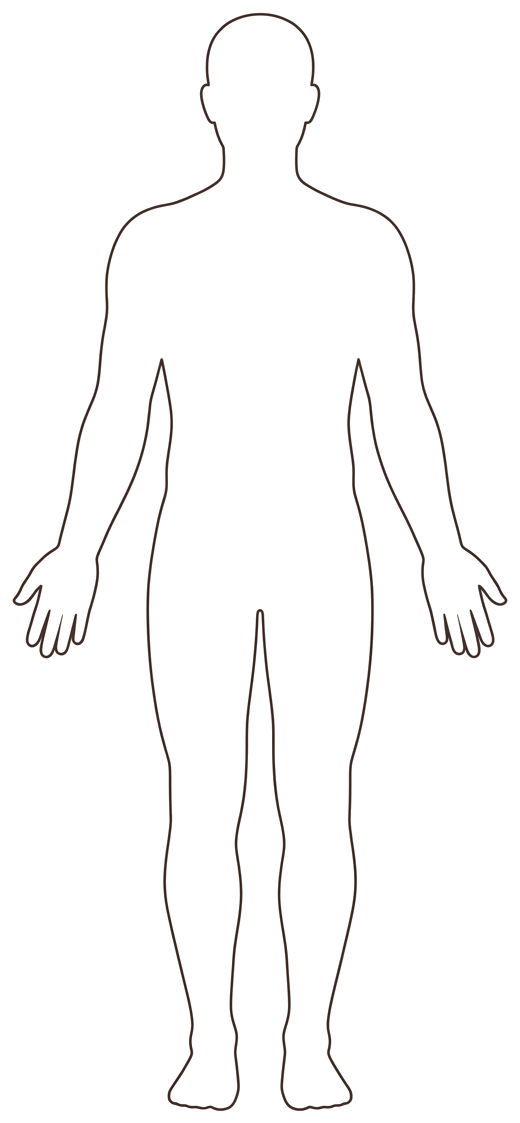
The easiest spots are the belly (about 2 inches either side of the navel), the love handles, the front of the thigh, and the back of the upper arms. Rotate every injection.
So which should a beginner pick? For almost everyone, subcutaneous is the answer: it is the route the research actually used, absorption is reliable, and the needle is tiny. The nasal spray is a reasonable needle-free alternative, but the dosing is fuzzier. Oral is not worth chasing.
Reconstitution: mixing it.
DSIP arrives as a dry powder, so before you can inject it you reconstitute it, which just means adding liquid to turn the powder into something you can draw into a syringe. It sounds technical but takes about a minute.
Once it is mixed, the only real question is how many units to draw. That depends on your vial size, your water amount, and your target dose, and because DSIP doses are tiny it is easy to get wrong by hand.
- Use bacteriostatic water, often called BAC water. The small amount of preservative keeps the mixed vial usable for weeks.
- Add the water slowly, down the inside wall of the vial. A common mix is a 5 mg vial plus 2 mL of BAC water, which gives a concentration of 2.5 mg/mL.
- Swirl, do not shake. Gently roll the vial until the powder dissolves. Shaking can damage the peptide.
- Store it in the fridge once mixed, and keep it out of direct light.
Open the dosage calculator to turn your vial and dose into an exact number of units. As a worked example: a 5 mg vial mixed with 2 mL of BAC water gives 2.5 mg/mL, so a 100 mcg dose is 0.04 mL, which is 4 units on a U-100 insulin syringe, and that vial holds about 50 doses.
Dosing by goal.
There is no single official dose for DSIP, because it is not an approved medicine. What follows is the range people commonly run, organized by how they tend to use it. The defining feature of DSIP dosing is that it is small and timed tightly to bedtime.
Standard nightly dose
The most common pattern is about 100 to 300 mcg, taken 30 to 60 minutes before bed. Because DSIP is short-acting, with a half-life often cited as roughly 15 to 30 minutes, timing it close to lights out is the point. Many people start at the low end and adjust.
Short courses, not nightly forever
Rather than running it every night indefinitely, people commonly use DSIP in short blocks, for example a 5 to 10 day stretch during a rough patch of sleep, or a two to four week cycle, then a break. This is partly habit and partly caution given the limited long-term data.
Paired with simple sleep supports
DSIP is often run alongside low-friction supports like magnesium glycinate, or a low dose of melatonin when sleep timing is also off. Stacking raises the risk of over-sedation, so the common advice is to change one variable at a time.
A low, conservative nightly dose taken 30 to 60 minutes before sleep. Good place to start and feel out the response.
Most reported use sits in this range. Run in short blocks rather than indefinitely, and keep the timing tight to bedtime.
Cycling and timing.
A cycle just means a defined run of time on the peptide, followed by a break. For DSIP the common pattern is a short block, a few days to a few weeks around poor sleep, rather than running it every single night forever.
Why not just run it forever? Mostly because the long-term human safety data does not exist, and because sleep aids in general are better used to reset a rough patch than relied on permanently. The cautious, widely followed approach is a focused block, then time off.
- Keep the timing tight, dosing 30 to 60 minutes before bed each night of a block, since the peptide is short-acting.
- Run short blocks, for example 5 to 10 nights or a two to four week cycle, rather than nightly indefinitely.
- Take a real break after a cycle before considering another. If sleep problems persist, that is a conversation for a licensed provider, not a forum.
Stacking DSIP.
DSIP is usually run on its own or with simple, gentle sleep supports rather than the heavy healing stacks. The goal is better sleep without piling on sedation.
Sleep & recovery
The low-friction pairing most people start with. DSIP is run for slow-wave depth while magnesium glycinate supports relaxation and muscle calm. It adds little risk of over-sedation, which is why it is the common entry point.
View stack →Sleep onset & depth
For nights when both timing and depth are off. A low dose of melatonin helps shift sleep onset while DSIP is run for delta-stage depth. Keep the melatonin low to avoid morning grogginess, and test one variable at a time.
View stack →See full recipes, dosing, and how people run them on the stacks page.
Side effects and safety.
In the reports we see, and in the older human studies, DSIP is generally described as well tolerated, with side effects that tend to be mild and temporary when they show up at all. The ones people mention most often are:
- Headache, occasionally reported, usually mild.
- Dizziness or mild grogginess, especially if dosed too late or too high.
- Vivid or unusually intense dreams, which some people find pleasant and others do not.
- Injection-site irritation, a little redness or a small bump, which is why rotating sites matters.
Who should be cautious.
Some people have clear reasons to be extra careful, or to avoid DSIP entirely until they have spoken with a licensed provider.
- Pregnant or breastfeeding. There is no safety data here, so this is a hard avoid.
- Anyone on sedatives or sleep medication. Combining DSIP with other sleep aids, alcohol, or sedating drugs raises the risk of excessive drowsiness. This is a conversation for your provider first.
- Competing athletes. DSIP is not currently named on WADA's list, but unapproved substances can fall under a catch-all category and contaminated peptides have caused failed tests, so caution is warranted.
- Anyone on other medications. If you take prescription drugs or manage a chronic condition, talk to your provider first.
And the universal one: whoever you are, talk to a licensed healthcare provider before starting DSIP. This guide is educational, not a substitute for personalized medical advice.
Where to buy it safely.
This is where a lot of beginners get burned, because peptide quality varies wildly between vendors and the cheapest vial is not always the real deal. Our honest take: do not shop on price alone, shop on price plus independent lab data.
- Compare vendors side by side. Price ranges are wide, and the difference between the lowest and highest listing can be large for the exact same compound.
- Look for recent third-party lab tests. The gold standard the community looks for is a recent Janoshik certificate of analysis showing purity for the batch you are actually buying.
- Favor recent COAs. An old lab result on a different batch tells you little. The fresher the test, the more it means.
- Be skeptical of suspiciously cheap listings with no testing behind them.
That is exactly the comparison we put together. On our DSIP product page you can compare vendor prices, see which batches have public lab data, and view the grades we assign from that data. From there you can head to the buy page to line up your options.
Questions, answered straight.
Is DSIP legal?
DSIP is not an approved drug and is not sold for human use. The vendors we compare offer it strictly for research use only. It is not currently named on WADA's prohibited list, but any unapproved substance can fall under WADA's catch-all category and contaminated peptides have caused failed tests, so competing athletes should be careful. Rules vary by country, so check what applies where you are.
Does DSIP actually work for sleep?
Honestly, the evidence is mixed. DSIP has been studied since the 1970s and some studies show more slow-wave sleep while others show none. The mechanism is still not fully understood, and one major review called it an unresolved riddle. Treat it as something studied for sleep, not a proven sleep medicine.
When should I take it?
Most people inject DSIP 30 to 60 minutes before bed, because it is short-acting with a half-life often cited as roughly 15 to 30 minutes. Timing it close to lights out is the whole point, so it is not something you take in the morning.
Is it addictive or does it cause tolerance?
Because DSIP does not appear to act directly on GABA-A receptors the way benzodiazepines do, it is theorized to carry a lower tolerance and dependence risk. That said, the long-term human data does not exist, so this is a theory, not a guarantee. Running it in short blocks is the cautious approach.
Subcutaneous or nasal spray?
Subcutaneous injection is the standard, best-studied route and the one research protocols used. A nasal spray exists and is needle-free, but its dosing is less standardized, so it is harder to know exactly how much you are getting. Oral forms are not practical because digestion breaks the peptide down.