The short version.
If you read nothing else, read this. The whole guide in a handful of bullets.
- What it is: ARA-290 (cibinetide) is an 11-amino-acid peptide derived from the tissue-protective part of erythropoietin, engineered to drop the blood-building effect.
- What people run it for: nerve pain, small-fiber neuropathy, and quieting inflammation, often stacked with BPC-157 for nerve and tissue repair.
- Typical dose: about 4 mg once daily, the dose used in the sarcoidosis trials, run for roughly four weeks at a time.
- Routes: subcutaneous injection is the standard, and the only route used in the human trials. It is not a meaningful oral peptide.
- Cycle: a focused block of roughly four weeks of daily dosing, then a break, rather than running it continuously.
- Honest caveat: ARA-290 has real but small human trials in sarcoidosis nerve pain, and it never reached approval. It is sold for research use only, and this is not medical advice.
Quick reference.
| Typical dose | 4 mg once daily |
|---|---|
| Routes | Subcutaneous injection (standard, trial route) |
| Frequency | Once a day during a cycle |
| Cycle length | ~4 week daily block, then a break |
| Best for | Nerve pain, small-fiber neuropathy, inflammation |
What is ARA-290?
ARA-290 is a short peptide, which simply means a small chain of amino acids, the same building blocks that make up the proteins in your body. It is sometimes called cibinetide, and it is built from a specific region of a natural protein called erythropoietin, or EPO.
EPO is best known for boosting red blood cell production, which is why it has a doping reputation. ARA-290 was deliberately engineered to keep only the tissue-protective part of EPO and strip out the blood-building part. So despite the EPO origin, it is not designed to thicken your blood.
The version sold by vendors arrives as a freeze-dried white powder in a small sealed vial. It is not a steroid, not a hormone in the usual sense, and not a stimulant. People reach for it because of one theme above all: it is studied for calming inflammation and helping injured nerves recover.
Worth saying plainly: ARA-290 is not an approved medicine anywhere. It is sold strictly for research use only. It does have real human trial data in sarcoidosis small-fiber neuropathy, which is more than many peptides can say, but those trials were small and it never reached the market. We get into what that means further down.
How it works in the body.
You do not need a biology degree to follow this. Here is the simple picture, then a little more for the curious.
The core idea is that ARA-290 switches on a repair receptor that mostly appears in injured or stressed tissue, so the signal lands where there is damage. It does this through a few overlapping mechanisms that show up in the research.
- The innate repair receptor. ARA-290 targets a receptor complex built from the EPO receptor and the beta-common receptor. This complex assembles mainly at sites of injury, so the peptide acts where tissue is stressed rather than everywhere at once.
- Small nerve fiber repair. In sarcoidosis trials it was studied for regrowing small nerve fibers, the tiny sensory nerves involved in neuropathic pain, with corneal imaging showing measurable nerve-fiber increases.
- Calmer inflammation. Activating the repair receptor appears to dial down excess inflammation and protect the vascular lining, which is part of why people associate it with less nerve discomfort.
How to take it: routes of administration.
ARA-290 is an injectable peptide. It is not a meaningful oral option, and the human trials all used subcutaneous injection, so the real choice is straightforward. Here is the honest comparison.
| Route | Typical dose | Absorption | Best for | Difficulty |
|---|---|---|---|---|
| Subcutaneous | 4 mg | Reliable, trial-proven | The standard route | Tiny needle, easy to learn |
| Intravenous | 2 mg | Immediate | Clinical settings only | Used in early trials, not for home use |
| Oral | Not practical | Very low | Not recommended | Poorly absorbed |
Subcutaneous injection
The standard route, and the one the Phase 2 trials used. A tiny insulin needle goes into the fat just under the skin, not into muscle. A simple subcutaneous shot into the belly works well, and it is far less intimidating than it sounds.
Intravenous
Some of the earliest exploratory trials gave ARA-290 intravenously a few times a week. That is a clinical procedure, not something for home use, and the later and larger trials moved to simple subcutaneous dosing instead.
Oral
ARA-290 is not a practical oral peptide. It is a peptide that does not survive digestion well, so capsule versions are not worth chasing. Stick to the injectable form.
Where to inject.
If you go this route, these are the sites people use. Rotate so no single area gets sore.
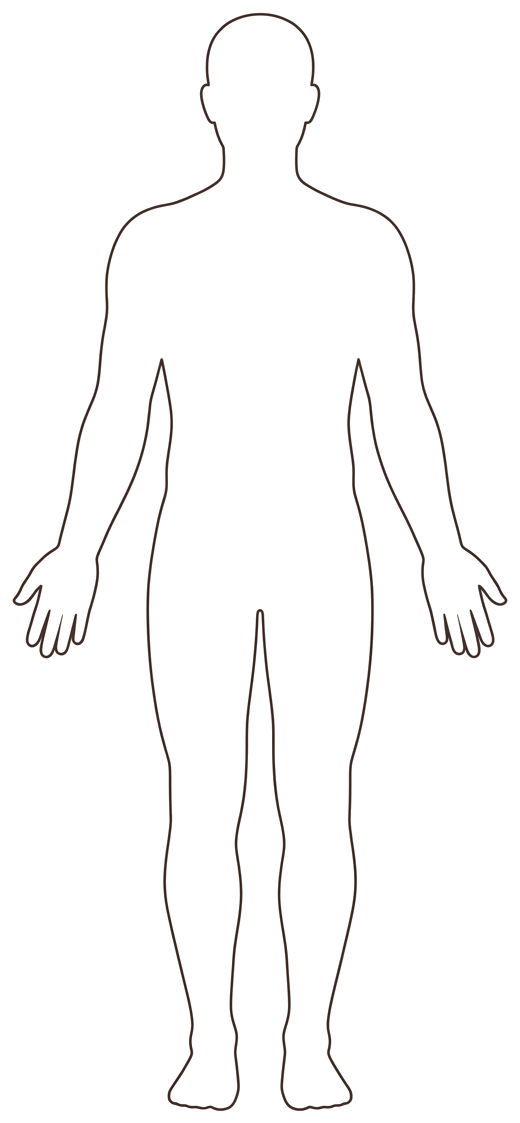
The easiest spots are the belly (about 2 inches either side of the navel), the love handles, the front of the thigh, and the back of the upper arms. Rotate every injection.
So which should a beginner pick? Subcutaneous is the answer for essentially everyone: it is the route the trials used, absorption is reliable, and the needle is tiny. Intravenous dosing belongs in a clinic, and oral is not worth chasing.
Reconstitution: mixing it.
ARA-290 arrives as a dry powder, so before you can inject it you reconstitute it, which just means adding liquid to turn the powder into something you can draw into a syringe. It sounds technical but takes about a minute.
Once it is mixed, the only real question is how many units to draw. That depends on your vial size, your water amount, and your target dose, and it is easy to get wrong by hand.
- Use bacteriostatic water, often called BAC water. The small amount of preservative keeps the mixed vial usable for weeks.
- Add the water slowly, down the inside wall of the vial. A common mix is a 10 mg vial plus 2 mL of BAC water, which gives a concentration of 5 mg/mL.
- Swirl, do not shake. Gently roll the vial until the powder dissolves. Shaking can damage the peptide.
- Store it in the fridge once mixed, and keep it out of direct light.
Open the dosage calculator to turn your vial and dose into an exact number of units. As a worked example: a 10 mg vial mixed with 2 mL of BAC water gives 5 mg/mL, so a 4 mg dose is 0.8 mL, which is 80 units on a U-100 insulin syringe, and that vial holds about two and a half doses.
Dosing by goal.
There is no single official dose for ARA-290, because it is not an approved medicine. What follows is the range people commonly run, anchored to the dose used in the clinical trials.
The trial dose
The most studied pattern is 4 mg once daily for about 28 days. In the dose-ranging work that compared 1 mg, 4 mg, and 8 mg, the 4 mg dose gave the strongest small-nerve-fiber response, which is why people anchor to it.
Running a cycle
People typically copy the trials and run a roughly four-week daily block, then take a break, rather than dosing indefinitely. Some repeat cycles if they feel they benefited, with time off in between.
Stacked with BPC-157
ARA-290 is often run alongside BPC-157 for nerve repair. The ARA-290 schedule stays the same, once daily; BPC-157 is also dosed daily but in micrograms, so the two run in the same block on different scales.
The dose used in the sarcoidosis trials and the one that gave the best nerve-fiber response. This is the standard reference point.
Run as a focused daily block of about four weeks, then a break. ARA-290 is run in cycles, not indefinitely.
Cycling and timing.
A cycle just means a defined run of time on the peptide, followed by a break. For ARA-290 the common pattern follows the trials: roughly four weeks of daily dosing, then time off, rather than running it indefinitely.
Why not just run it forever? Mostly because the long-term human safety data does not exist yet. The trials lasted weeks to a few months, not years, so the cautious approach is a focused block, then stop.
- Hold the daily schedule through your block, at roughly the same time each day.
- Anchor to the trial dose rather than escalating, since 4 mg was the dose that performed best in testing.
- Take a real break after a cycle before considering another. If symptoms return, that is a conversation for a licensed provider.
Stacking ARA-290.
ARA-290 is often paired rather than run alone, usually when nerve discomfort and inflammation are the target.
Neuropathy & recovery
The repair-focused pair people reach for with nerve pain. ARA-290 works on the innate repair receptor and small nerve fibers, while BPC-157 adds local soft-tissue and gut support. Two different mechanisms aimed at the same recovery goal.
View stack →Inflammation & tissue
ARA-290 quiets inflammation through the innate repair receptor, while TB-500 is run for whole-body recovery and mobility. People reach for this when both nerve discomfort and soft-tissue recovery are in play.
View stack →See full recipes, dosing, and how people run them on the stacks page.
Side effects and safety.
In the trials and reports we see, ARA-290 is generally described as well tolerated, with side effects that tend to be mild and temporary when they show up at all. The ones people mention most often are:
- Injection-site stinging or mild irritation, a little redness or a small bump, which is why rotating sites matters.
- Transient headache reported by some people around dosing.
- Mild tiredness sometimes mentioned, usually settling quickly.
- General mild, short-lived effects rather than anything dramatic in the trial reports.
Who should be cautious.
Some people have clear reasons to be extra careful, or to avoid ARA-290 entirely until they have spoken with a licensed provider.
- Pregnant or breastfeeding. There is no safety data here, so this is a hard avoid.
- A history of cancer, or active cancer. Because tissue-repair and vascular-protective signaling overlap with processes tumors rely on, caution is widely advised. This is a conversation for an oncologist, not a forum.
- Clotting or cardiovascular concerns. Although ARA-290 is engineered to avoid EPO's blood-thickening effect, anyone with a clotting or heart history should clear it with a provider first.
- Anyone on other medications. If you take prescription drugs or manage a chronic condition, talk to your provider first.
And the universal one: whoever you are, talk to a licensed healthcare provider before starting ARA-290. This guide is educational, not a substitute for personalized medical advice.
Where to buy it safely.
This is where a lot of beginners get burned, because peptide quality varies wildly between vendors and the cheapest vial is not always the real deal. Our honest take: do not shop on price alone, shop on price plus independent lab data.
- Compare vendors side by side. Price ranges are wide, and the difference between the lowest and highest listing can be large for the exact same compound.
- Look for recent third-party lab tests. The gold standard the community looks for is a recent Janoshik certificate of analysis showing purity for the batch you are actually buying.
- Favor recent COAs. An old lab result on a different batch tells you little. The fresher the test, the more it means.
- Be skeptical of suspiciously cheap listings with no testing behind them.
That is exactly the comparison we put together. On our ARA-290 product page you can compare vendor prices, see which batches have public lab data, and view the grades we assign from that data. From there you can head to the buy page to line up your options.
Questions, answered straight.
Is ARA-290 legal?
ARA-290 is not an approved drug and is not sold for human use. The vendors we compare offer it strictly for research use only. It holds FDA orphan-drug status for sarcoidosis nerve pain but never reached approval. Rules vary by country, so check what applies where you are.
Is ARA-290 the same as EPO?
Not quite. ARA-290 is built from the tissue-protective region of erythropoietin but was deliberately engineered to drop the blood-building effect. It does not raise red blood cell count the way EPO does; it targets the innate repair receptor instead.
How is it different from BPC-157?
BPC-157 acts mostly locally on soft tissue and the gut and works orally or by injection. ARA-290 targets the innate repair receptor at injured nerves and is really only practical as a subcutaneous injection. They are run together so often for nerve repair that the pair is a common stack.
How long until it works?
Effects tend to build over weeks rather than days. The trials ran for about four weeks before measuring nerve and pain changes, so it is not an overnight switch.
Does it need refrigeration?
Keep the sealed, freeze-dried vial in the fridge and out of light. Once you mix it with bacteriostatic water, store it refrigerated and use it within a few weeks. Do not freeze a reconstituted vial.
How do I figure out the dose in units?
Use our calculator. Enter your vial size, how much bacteriostatic water you added, and your target dose, and it tells you exactly how many units to draw on a U-100 syringe. The dosage calculator handles the math for you.