The short version.
If you read nothing else, read this. The whole guide in a handful of bullets.
- What it is: Cerebrolysin is a liquid mix of small peptides and free amino acids made from purified pig brain tissue. It is designed to mimic the brain's own growth factors.
- What people run it for: cognitive recovery and brain support, studied most in stroke, traumatic brain injury, and dementia, and sometimes stacked with Semax and Selank for everyday cognition.
- Typical dose: about 5 mL once daily by intramuscular injection for a course of 10 to 20 days, repeated as a few courses per year.
- Routes: intramuscular injection for everyday doses up to 5 mL, intravenous infusion in a clinic for larger doses. It is not an oral peptide.
- Cycle: daily injections in a defined course of a few weeks, then a treatment-free break of two to three months before any repeat course.
- Honest caveat: Cerebrolysin has many clinical trials, but results are mixed and reviewers rate the overall evidence low to moderate. It is approved in some countries, not in the US, and is sold for research use only. This is not medical advice.
Quick reference.
| Typical dose | 5 mL once daily, in a 10 to 20 day course |
|---|---|
| Routes | Intramuscular (everyday), intravenous infusion (clinic, larger doses) |
| Frequency | Daily during a course, then a treatment-free break |
| Cycle length | 10 to 20 day course, repeated a few times a year |
| Best for | Cognitive recovery and brain support, studied in stroke, TBI, dementia |
What is Cerebrolysin?
Cerebrolysin is not a single peptide. It is a preparation, which means a mixture, of low-weight peptides and free amino acids produced from purified pig brain tissue through a controlled enzymatic process. The goal is to capture small fragments that behave like the brain's own growth and repair signals.
Those signals are called neurotrophic factors, the most famous being BDNF and NGF. They help neurons survive stress, form new connections, and in some cases be replaced. Cerebrolysin is studied for delivering peptides that act on the same pathways, which is why it sits in the cognitive and neuro-repair category.
Unlike most research peptides, Cerebrolysin does not arrive as a freeze-dried powder. It is a ready-to-use amber liquid sealed in glass ampoules at a standard strength of 215.2 mg per mL. There is no mixing step, you draw it straight from the ampoule.
Worth saying plainly: Cerebrolysin is an approved medicine in a number of countries, but it is not approved by the FDA in the US, where it is sold strictly for research use only. And while it has been studied for decades, the trial results are genuinely mixed. We get into what that means further down.
How it works in the body.
You do not need a neuroscience degree to follow this. Here is the simple picture, then a little more for the curious.
The core idea is that Cerebrolysin works with the brain's own repair machinery. Instead of acting like a stimulant, it is studied for supplying neurotrophic-like signals that help neurons survive and reconnect. It seems to do this through several overlapping mechanisms.
- Neurotrophic mimicry. Its peptides are studied for acting like BDNF, NGF, and CNTF, the growth factors that keep neurons alive and help them build new connections. This is the headline mechanism.
- Neuroplasticity and neurogenesis. It is studied for supporting the brain's ability to rewire itself, and in animal work for encouraging the birth of new neurons, which is part of why it is researched in recovery after injury.
- Calmer neuroinflammation and less cell breakdown. It appears to dial down excess inflammation in the brain and to slow calpain-driven neuronal damage, both of which matter when tissue is trying to recover from stress or injury.
How to take it: routes of administration.
Cerebrolysin is an injectable preparation, and because it is a relatively large liquid volume the route depends mostly on your dose. Here is the honest comparison.
| Route | Typical dose | Absorption | Best for | Difficulty |
|---|---|---|---|---|
| Intramuscular | Up to 5 mL | Reliable | Everyday research use | Practical at home, slow push |
| Intravenous | 10 to 50 mL | Immediate, systemic | Larger clinical doses | Clinic only, diluted infusion |
| Oral | Not practical | Negligible | Not recommended | Does not survive digestion |
Intramuscular injection
The practical route for everyday research use. The pre-mixed solution goes into a large muscle, pushed slowly over about three minutes using the Z-track method. Doses above 5 mL by this route should be split across two sites.
Intravenous infusion
How the larger clinical doses are given. The solution is diluted in saline and infused over 15 to 60 minutes under supervision. This is the route used in most stroke and traumatic brain injury trials, not something done at home.
Oral
Cerebrolysin is a mix of peptides and amino acids that does not survive digestion in any meaningful way, so there is no practical oral version. Capsule products are not worth chasing. It is an injectable preparation only.
Where to inject.
If you go this route, these are the sites people use. Rotate so no single area gets sore.
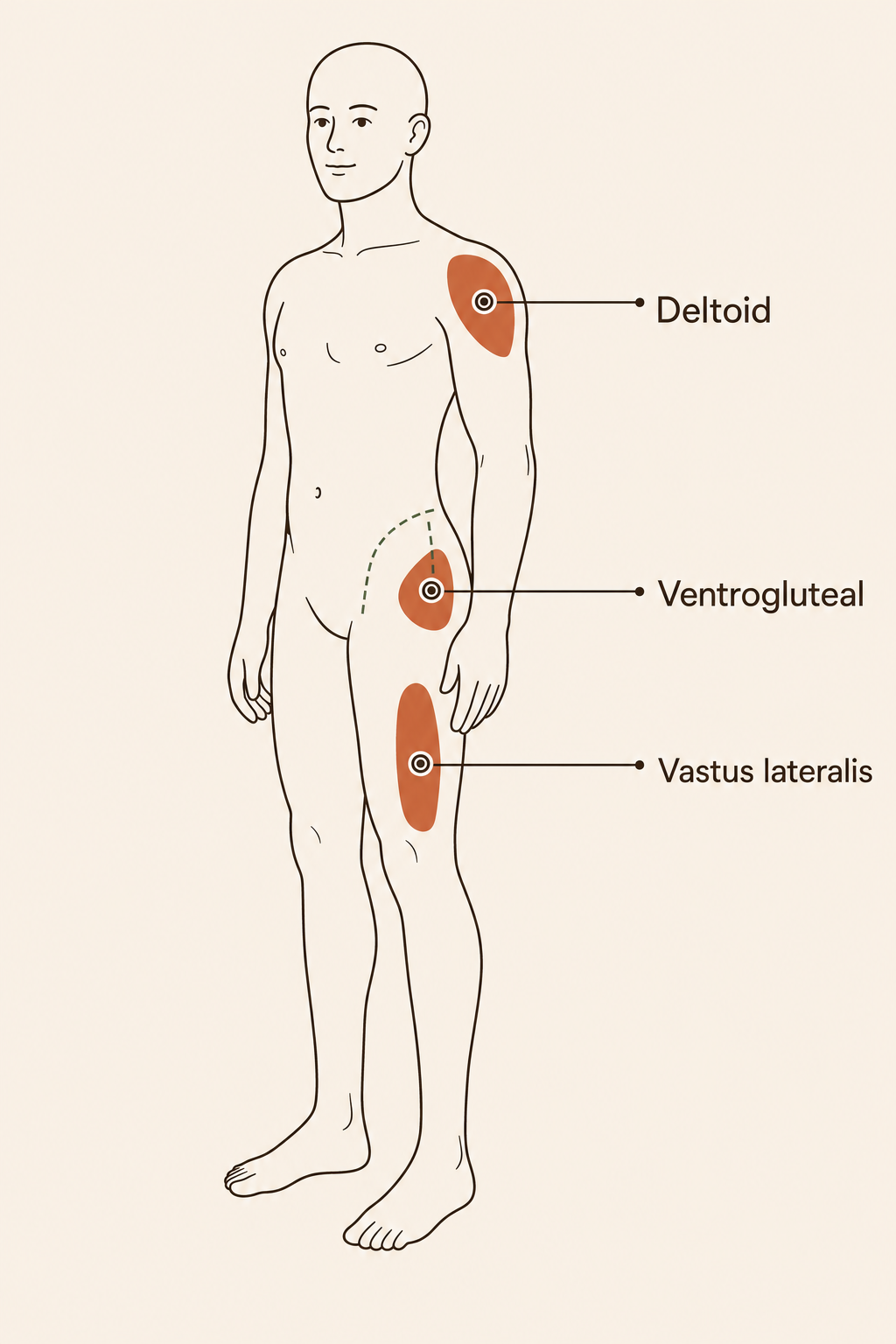
Inject into muscle: the shoulder (deltoid), the hip (ventrogluteal), or the outer thigh (vastus lateralis). Rotate every injection.
So which applies to you? For at-home research use, intramuscular is the practical answer, with everyday doses up to 5 mL drawn straight from the ampoule. Intravenous is reserved for the large clinical doses used in stroke and TBI care, and it belongs in a supervised setting, not a kitchen.
Dosing by goal.
There is no single official nootropic dose for Cerebrolysin, because its approved uses are clinical. What follows is the range people commonly run, alongside the much larger doses used in the trials. The defining feature is the course-then-break pattern.
Everyday research dose
For cognitive support, people commonly run about 5 mL once daily by intramuscular injection. That is one 5 mL ampoule, given as a slow push, for a defined course rather than continuously.
Clinical dose range
The stroke and traumatic brain injury trials use far larger doses, typically 10 to 30 mL daily by slow intravenous infusion in a hospital. These are not home doses and are well above what nootropic users run.
Course and repeat
For dementia, a standard course is roughly four weeks at five days a week, repeated after a treatment-free break of two to three months until no further benefit is seen. Nootropic users borrow this course-then-break shape with shorter 10 to 20 day runs.
One 5 mL ampoule once daily by intramuscular injection, run as a defined course rather than indefinitely. This is the common nootropic pattern.
The larger doses used in stroke and TBI trials, given by slow intravenous infusion in a clinic. Listed for context, not as a home protocol.
Cycling and timing.
A cycle, or course, just means a defined run of daily injections followed by a break. For Cerebrolysin the established pattern is a course of a few weeks, then a treatment-free period of two to three months before any repeat, rather than running it indefinitely.
Why not run it forever? Because the benefit is described as building over a course and then holding, and because continuous long-term self-administration has no safety data behind it. The cautious, widely followed approach is a focused course, then a real break.
- Run a defined course, daily injections for roughly 10 to 20 days for nootropic use, or the four-week clinical course where that applies.
- Take a real treatment-free break of two to three months before considering another course.
- Judge across the whole course, not day to day, since effects are described as gradual. If you have a neurological condition, this is a conversation for a licensed provider.
Stacking Cerebrolysin.
Cerebrolysin is often the neuro-repair base of a cognitive stack rather than a solo act. It pairs naturally with the nasal nootropic peptides people run for focus and calm.
Focus & repair
The popular cognitive trio. Cerebrolysin supplies the neurotrophic-like repair base, Semax is run for focus and drive, and Selank is run for calm and stress balance. Each is on its own rhythm in the same block.
View stack →Recovery & drive
A streamlined pair. Cerebrolysin delivers neurotrophic-like peptides while Semax is studied for upregulating the brain's own BDNF, so the two are run as complementary signals for recovery plus drive.
View stack →See full recipes, dosing, and how people run them on the stacks page.
Side effects and safety.
In the reports and trial data we see, Cerebrolysin is generally described as well tolerated, with side effects that tend to be mild and often tied to the injection itself. The ones mentioned most often are:
- Nausea or dizziness, sometimes reported around the time of injection, especially if pushed too fast.
- Headache or sweating, noted in some users shortly after a dose.
- Agitation, insomnia, or restlessness, linked to the mild stimulatory effect, which is why some avoid late-day dosing.
- Injection-site irritation, a little soreness or redness, which is why rotating muscles and a slow push matter.
Who should be cautious.
Some people have clear reasons to be extra careful, or to avoid Cerebrolysin entirely until they have spoken with a licensed provider.
- Epilepsy or a seizure disorder. Cerebrolysin is contraindicated here, because its stimulatory effect can increase the frequency of seizures. This is a hard avoid without medical guidance.
- Severe kidney impairment. Severe renal impairment is a listed contraindication, so anyone with significant kidney disease should steer clear.
- Known allergy or allergic diathesis. Because it is derived from pig brain tissue, hypersensitivity reactions are possible, and a strong allergic tendency calls for caution.
- Pregnant or breastfeeding. Human safety data is lacking, so use should be avoided unless a doctor judges it strictly necessary.
And the universal one: whoever you are, talk to a licensed healthcare provider before starting Cerebrolysin. This guide is educational, not a substitute for personalized medical advice.
Where to buy it safely.
This is where a lot of beginners get burned, because peptide quality varies wildly between vendors and the cheapest option is not always the real deal. Our honest take: do not shop on price alone, shop on price plus independent lab data.
- Compare vendors side by side. Price ranges are wide, and the difference between the lowest and highest listing can be large for the same product and ampoule size.
- Check the ampoule size and concentration. Genuine Cerebrolysin is a 215.2 mg/mL solution in sealed glass ampoules. Confirm you are comparing the same volume.
- Look for recent third-party testing where available, and be wary of listings with no batch information behind them.
- Be skeptical of suspiciously cheap listings, since counterfeits of an injectable, animal-derived product carry real contamination risk.
That is exactly the comparison we put together. On our Cerebrolysin product page you can compare vendor prices, see which listings have public lab data, and view the grades we assign from that data. From there you can head to the buy page to line up your options.
Questions, answered straight.
Is Cerebrolysin legal?
Cerebrolysin is an approved prescription medicine in a number of countries in Europe and Asia, but it is not approved by the FDA in the US. The vendors we compare offer it strictly for research use only. It is not currently on WADA's prohibited list, so rules vary by country, check what applies where you are.
What is Cerebrolysin actually made of?
It is a preparation of low-weight peptides and free amino acids produced from purified pig brain tissue through a controlled enzymatic process. The aim is to capture small fragments that behave like the brain's own neurotrophic factors, such as BDNF and NGF.
Does it need to be reconstituted?
No. Unlike freeze-dried peptides, Cerebrolysin ships as a ready-to-use amber liquid in sealed glass ampoules at 215.2 mg/mL. You draw it straight from the ampoule, so there is no powder and no bacteriostatic water step.
How long until it works?
Effects are described as gradual, building across a multi-week course rather than from a single dose. Many people judge it only after a full 10 to 20 day run. It is not an overnight switch.
IM or IV?
For at-home research use, intramuscular is the practical route, and doses up to 5 mL go undiluted into a large muscle with a slow push. Larger doses of 10 mL or more are given intravenously, diluted in saline and infused over 15 to 60 minutes in a clinical setting. Cerebrolysin is not an oral peptide.
Does it need refrigeration?
Cerebrolysin is generally stored at room temperature and out of direct light, not frozen. Do not use any ampoule that has changed color or turned cloudy, and follow the storage guidance on the specific product you buy.