Cerebrolysin
A liquid preparation of low-weight peptides and free amino acids made from purified pig brain tissue. People run it for cognitive recovery and brain support, studied most in stroke, traumatic brain injury, and dementia, and sometimes stacked with Semax and Selank.
Where to buy Cerebrolysin.
We track Cerebrolysin across vetted vendors, but none is publicly listing a verifiable price right now. As soon as one does, it shows up here, cheapest first.
Cerebrolysin
No vetted vendor is publicly listing Cerebrolysin at a price we can verify yet. We don't show prices we can't stand behind, so this stays empty until one does.
Compare Cerebrolysin with other peptides →What Cerebrolysin actually does.
The simple version first, then a little more for the curious. No biochem degree required.
It delivers neurotrophic-like signals to brain cells, the same kind of growth and repair cues your own brain uses, so neurons can survive stress, form new connections, and recover.
How it works
Cerebrolysin is a mix of small peptides and free amino acids that mimic neurotrophic factors like BDNF, NGF, and CNTF. They are studied for binding neurotrophin pathways in the brain and switching on signals that keep neurons alive and help them rebuild connections.
Where it acts
It acts in the central nervous system, where it is studied for reducing neuroinflammation, slowing calpain-driven cell breakdown, and supporting neuroplasticity and the birth of new neurons. The clinical work centers on stroke, traumatic brain injury, and dementia.
What people notice
In research settings people report clearer thinking, better memory, and steadier recovery after a brain injury. Effects are described as gradual, building across a multi-week course rather than from a single dose.
Honest caveat: Cerebrolysin has decades of clinical trials behind it, but results are mixed and many studies are small or industry-funded, so reviewers call the overall evidence low to moderate quality. It is an approved medicine in some countries but not in the US, where it is sold strictly for research use only. None of this is medical advice, talk to a licensed provider before starting anything.
How to take it.
Cerebrolysin is an injection, given intramuscularly into a large muscle for everyday doses up to 5 mL, or intravenously in a clinic for larger doses. It ships as a ready-to-use amber liquid in sealed ampoules, so there is no powder to mix. The routine is below; for cycling and timing, see the full guide.
Open the ampoule
Cerebrolysin comes pre-mixed in a glass ampoule at 215.2 mg/mL, so there is nothing to reconstitute. Snap the top, wipe, and draw the solution into a syringe.
Draw your dose
A common nootropic dose is 5 mL, which is one 5 mL ampoule. Doses above 5 mL by the IM route should be split between two injection sites, or given intravenously in a clinic instead.
Set the Z-track and inject
Swab the skin, pull it sideways for the Z-track, insert at 90° into the muscle, aspirate, then push slowly over about three minutes. Slow delivery matters for an IM solution this large.
Rotate your sites
Move to a different muscle each day so no area gets sore. Store the ampoules at room temperature, out of light, and use them within a single course.
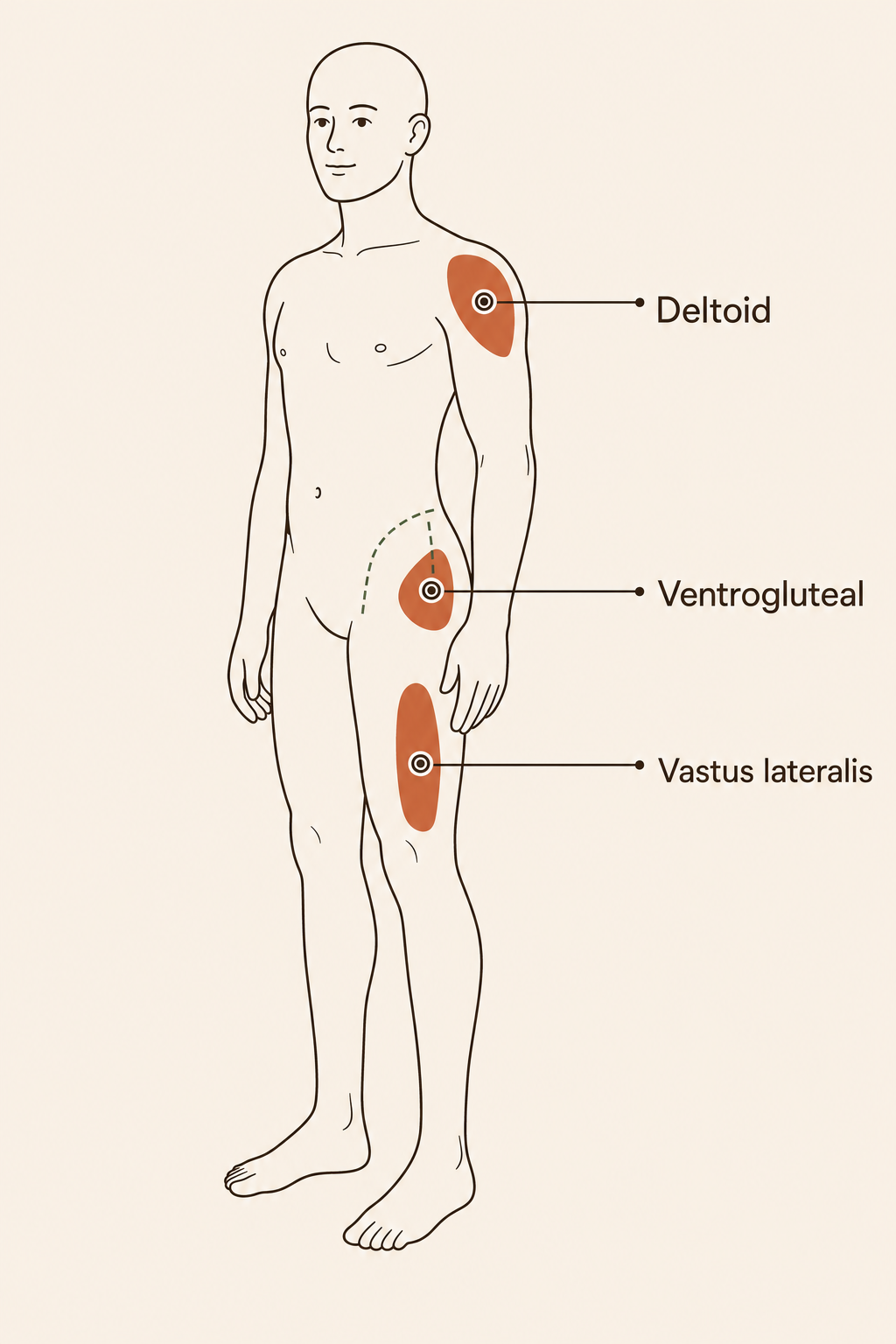
Inject into muscle: the shoulder (deltoid), the hip (ventrogluteal), or the outer thigh (vastus lateralis). Use the Z-track method and rotate.
Typical Cerebrolysin dose: about 5 mL once daily by IM injection for a course of 10 to 20 days, repeated as a few courses per year with breaks between them. Clinical stroke and TBI protocols use much larger IV doses under supervision.
How to cycle Cerebrolysin.
How long people run Cerebrolysin, when to take a break, and the honest reasoning behind it.
A few courses per year with breaks between.
A cycle, or course, just means a defined run of daily injections followed by a break. For Cerebrolysin the established pattern is a course of a few weeks, then a treatment-free period of two to three months before any repeat, rather than running it indefinitely.
Why not run it forever? Because the benefit is described as building over a course and then holding, and because continuous long-term self-administration has no safety data behind it. The cautious, widely followed approach is a focused course, then a real break.
- Run a defined course, daily injections for roughly 10 to 20 days for nootropic use, or the four-week clinical course where that applies.
- Take a real treatment-free break of two to three months before considering another course.
- Judge across the whole course, not day to day, since effects are described as gradual. If you have a neurological condition, this is a conversation for a licensed provider.
Want the full picture, on and off periods, the washout, stacking, and keeping your results? Read how peptide cycling works →
What's actually in the vial.
We haven't yet found a vendor publishing a lab certificate for Cerebrolysin that we can link to directly. We don't post purity numbers we can't source. When a vendor publishes a real Cerebrolysin COA, it'll show up here.
What people pair it with.
Cerebrolysin is often the neuro-repair base of a cognitive stack. These are the combinations people reach for when brain support is the goal.
Focus & repair
The popular cognitive trio. Cerebrolysin supplies the neurotrophic-like repair base, Semax is run for focus and drive, and Selank is run for calm and stress balance. The three are dosed on their own rhythms in the same block.
View stack →Recovery & drive
A streamlined pair for cognitive recovery. Cerebrolysin delivers neurotrophic-like peptides while Semax is studied for upregulating the brain's own BDNF, so the two are run as complementary signals.
View stack →Brain & energy
A recovery-focused combination. Cerebrolysin targets neuronal repair while NAD+ is run for cellular energy and mitochondrial support. Both are injectables run in defined courses rather than indefinitely.
View stack →In the same corner.
Other cognitive and nootropic peptides people compare against Cerebrolysin.
Questions, answered straight.
Is Cerebrolysin legal?
Cerebrolysin is an approved prescription medicine in a number of countries in Europe and Asia, but it is not approved by the FDA in the US. The vendors we compare offer it strictly for research use only. It is not currently on WADA's prohibited list, but rules vary by country, so check what applies where you are.
What does research use only actually mean?
It means the product is sold for laboratory and research purposes, not as a supplement or medicine for people in the US. It has not been reviewed or approved for human use by the FDA. We aggregate prices and public lab data so you can see the landscape; what you do with that is between you and a licensed provider.
Does it need to be reconstituted?
No. Unlike freeze-dried peptides, Cerebrolysin ships as a ready-to-use amber liquid in sealed glass ampoules at 215.2 mg/mL. You draw it straight from the ampoule, so there is no powder and no bacteriostatic water step. Store the ampoules at room temperature and out of light.
How often do people dose it?
A common pattern is about 5 mL once daily by IM injection for a course of 10 to 20 days, then a break, repeated as a few courses per year. Clinical stroke and TBI trials use much larger intravenous doses, 10 to 30 mL daily, given in a hospital over a slow infusion.
IM or IV?
For at-home research use, intramuscular is the practical route, and doses up to 5 mL go undiluted into a large muscle. Larger doses of 10 mL or more are given intravenously, diluted in saline and infused over 15 to 60 minutes in a clinical setting. Cerebrolysin is not an oral peptide.