The short version.
If you read nothing else, read this. The whole guide in a handful of bullets.
- What it is: IGF-1 LR3 is a long-acting synthetic analog of insulin-like growth factor 1, a growth signal your body makes downstream of growth hormone. The LR3 tweaks make it last hours instead of minutes.
- What people run it for: muscle growth, satellite-cell activation, and faster recovery, usually inside a short bulking block and often stacked with a GH peptide like CJC-1295 or Ipamorelin.
- Typical dose: about 20 to 50 mcg per day, run in short cycles of roughly four to six weeks.
- Routes: intramuscular into a muscle belly is common; subcutaneous into fat also works. It is not a meaningful oral peptide.
- Cycle: short blocks of four to six weeks, then time off, rather than running it continuously.
- Honest caveat: there are no controlled human trials behind the muscle claims, and the long half-life makes the low-blood-sugar risk more serious. It is sold for research use only, and this is not medical advice.
Quick reference.
| Typical dose | 20 to 50 mcg per day |
|---|---|
| Routes | Intramuscular injection (common), subcutaneous into fat |
| Frequency | Daily or every other day during a cycle |
| Cycle length | ~4 to 6 weeks, then time off, in cycles |
| Best for | Muscle growth, hypertrophy, recovery through a hard block |
What is IGF-1 LR3?
IGF-1 LR3 is a peptide, which simply means a chain of amino acids, the same building blocks that make up the proteins in your body. It is a synthetic, modified copy of insulin-like growth factor 1, a hormone your body already produces in response to growth hormone.
Natural IGF-1 is one of the main signals that actually carries out growth hormone's effects, telling muscle and other tissue to grow and repair. The problem is that it is cleared from the blood in minutes. The LR3 version adds an extended N-terminal region and swaps one amino acid, which stops the carrier proteins from grabbing it, so it stays active far longer.
The version sold by vendors arrives as a freeze-dried white powder in a small sealed vial, often a 1 mg size. It is not a steroid and not a stimulant, but it is a powerful growth signal. People reach for it for one theme above all: building muscle and recovering faster during a focused training block.
Worth saying plainly: IGF-1 LR3 is not an approved medicine for muscle building anywhere. It is sold strictly for research use only, there are no controlled human trials behind the muscle claims, and its long half-life makes its insulin-like, blood-sugar-lowering effects more of a concern, not less. We get into what that means further down.
How it works in the body.
You do not need a biology degree to follow this. Here is the simple picture, then a little more for the curious.
The core idea is that IGF-1 LR3 copies a growth signal your body already uses, but it is engineered to hang around. It does this through a few mechanisms that show up repeatedly in the research.
- IGF-1 receptor signaling. It binds the same receptor as natural IGF-1 and switches on the PI3K/Akt pathway, which drives protein synthesis, and the MAPK/ERK pathway, which drives cell proliferation. Together these tell muscle to grow.
- Satellite-cell activation. In skeletal muscle it is studied for waking up satellite cells, the repair cells that fuse into fibers, which is the basis for the hypertrophy and even hyperplasia people talk about.
- Insulin-like glucose effects. Because IGF-1 and insulin are cousins, it also pushes glucose into muscle and fat tissue and lowers blood sugar. This is part of why it is anabolic, and exactly why the hypoglycemia warnings exist.
How to take it: routes of administration.
IGF-1 LR3 is an injectable peptide. It is not a meaningful oral option, so the real choice is just where you inject. Here is the honest comparison.
| Route | Typical dose | Absorption | Best for | Difficulty |
|---|---|---|---|---|
| Intramuscular | 20 to 50 mcg | High, into muscle | Muscle-focused cycles | Z-track, deeper needle |
| Subcutaneous | 20 to 50 mcg | Reliable, systemic | Simplicity, easy dosing | Tiny needle, easy to learn |
| Oral | Not practical | Very low | Not recommended | Destroyed by digestion |
Intramuscular
A common route with IGF-1 LR3, partly because people like the idea of placing the growth signal into a muscle belly. The needle goes deeper than a subcutaneous shot and the Z-track method is used to seal the channel. It is a bit more involved, but straightforward once you have done it.
Subcutaneous injection
The simplest option. A tiny insulin needle goes into the fat just under the skin. Because IGF-1 LR3 circulates systemically anyway, a subcutaneous shot is plenty effective and far less intimidating. After reconstitution it is the same draw as the intramuscular route.
Oral
IGF-1 LR3 is a protein that does not survive digestion, so there is no practical oral version. Capsule listings are not worth chasing. Stick to the injectable form, whichever site you choose.
Where to inject.
If you go this route, these are the sites people use. Rotate so no single area gets sore.
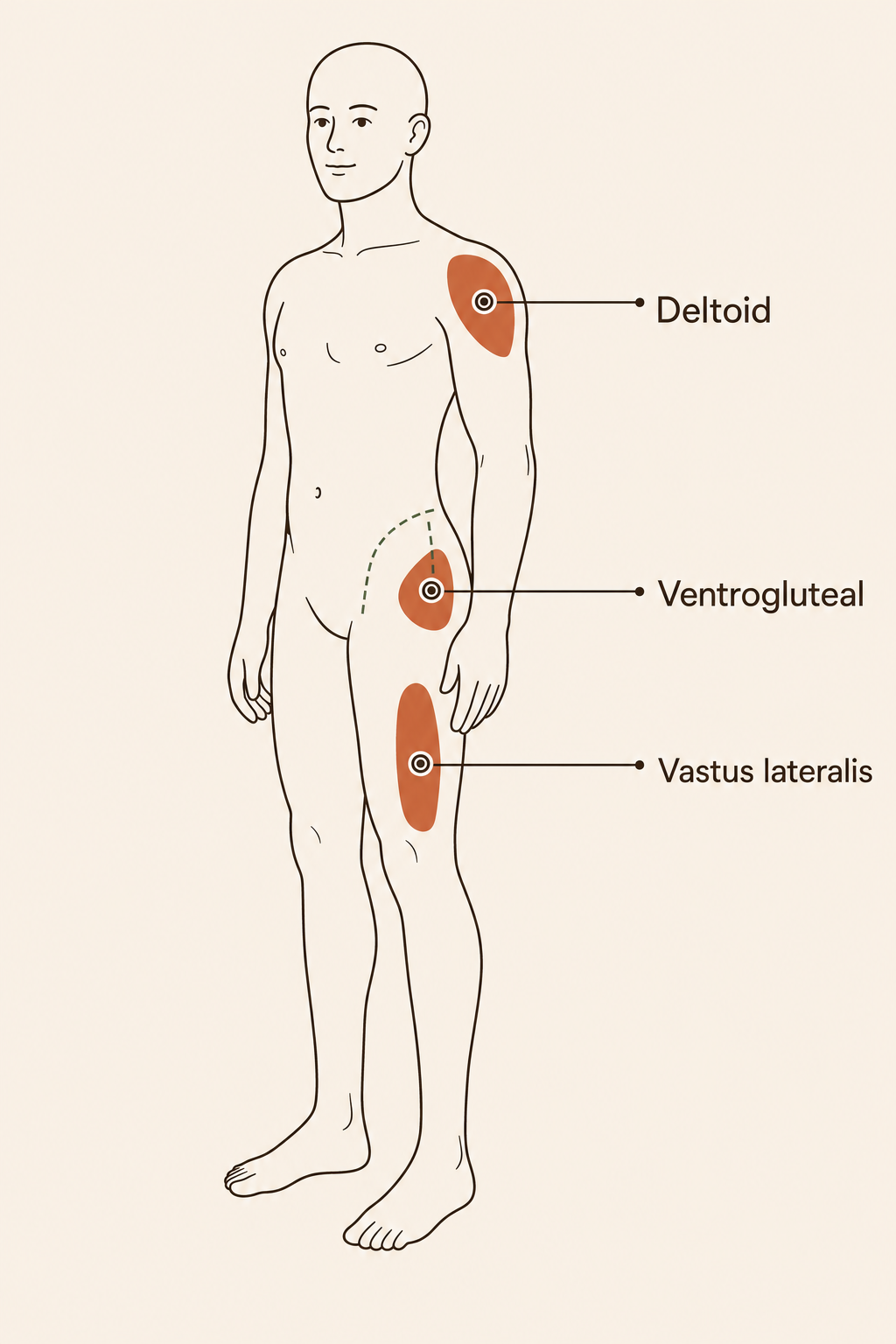
Inject into muscle: the shoulder (deltoid), the hip (ventrogluteal), or the outer thigh (vastus lateralis). Rotate every injection.
So which should a beginner pick? Both work because IGF-1 LR3 acts systemically once it is in. Subcutaneous into the belly is the easiest to learn and the least intimidating. Intramuscular is popular in muscle-building circles and is the lead route many people use, but it asks for the Z-track technique and a steadier hand.
Reconstitution: mixing it.
IGF-1 LR3 arrives as a dry powder, so before you can inject it you reconstitute it, which just means adding liquid to turn the powder into something you can draw into a syringe. It sounds technical but takes about a minute.
Once it is mixed, the only real question is how many units to draw. Because IGF-1 LR3 is dosed in micrograms, the numbers are small and easy to get wrong by hand, so the calculator earns its keep here.
- Use bacteriostatic water, often called BAC water. The small amount of preservative keeps the mixed vial usable for weeks.
- Add the water slowly, down the inside wall of the vial. A common mix is a 1 mg vial plus 2 mL of BAC water, which gives a concentration of 500 mcg/mL.
- Swirl, do not shake. Gently roll the vial until the powder dissolves. IGF-1 LR3 is delicate, and shaking can damage the peptide.
- Store it in the fridge once mixed, and keep it out of direct light.
Open the dosage calculator to turn your vial and dose into an exact number of units. As a worked example: a 1 mg vial mixed with 2 mL of BAC water gives 500 mcg/mL, so a 40 mcg dose is 0.08 mL, which is 8 units on a U-100 insulin syringe, and that vial holds about 25 doses.
Dosing by goal.
There is no single official dose for IGF-1 LR3, because it is not an approved medicine. What follows is the range people commonly run, organized by experience. The defining features of IGF-1 LR3 dosing are small microgram amounts and short cycles.
Conservative start
A common starting pattern is about 20 to 40 mcg, taken daily or every other day, for around four weeks. Starting low lets you see how your blood sugar responds before pushing the dose.
Intermediate range
More experienced users often run roughly 50 mcg per day across a four to six week block. Past this point the extra growth signal comes with a steeper rise in the insulin-like risks, so most people do not chase higher numbers.
Timing around food
Because of the blood-sugar drop, the common approach is to dose post-workout on training days alongside a meal, or in the morning with food on rest days. Carbohydrate near the dose blunts the hypoglycemia.
Daily or every other day for about four weeks. Start here so you can see how your blood sugar reacts before going higher.
A four to six week block at around 50 mcg. Most people treat this as a practical ceiling rather than a starting point.
Cycling and timing.
A cycle just means a defined run of time on the peptide, followed by a break. For IGF-1 LR3 the common pattern is a short block of four to six weeks, then time off, rather than running it for months.
Why keep it short? Partly because the long-term human safety data does not exist, and partly because a sustained, long-acting growth signal is exactly the kind of thing you do not want to leave switched on indefinitely. The cautious and widely followed approach is a focused block, then a real break.
- Hold a short block, four to six weeks, at a steady daily or every-other-day schedule.
- Do not creep the dose up mid-cycle chasing more. The risks climb faster than the reward.
- Take a real break after a cycle before considering another. Any decision to repeat is a conversation for a licensed provider.
Stacking IGF-1 LR3.
IGF-1 LR3 is rarely run alone. It is usually one piece of a growth-hormone-and-IGF block built around muscle gain.
Growth & recovery
The most popular GH-and-IGF combination. CJC-1295 and Ipamorelin push your own growth-hormone pulses, while IGF-1 LR3 adds the downstream growth signal directly. The classic mass-and-recovery trio people reach for.
View stack →Oral GH base
An easy base plus a targeted push. MK-677 is an oral pill that raises GH and IGF-1 around the clock, and IGF-1 LR3 layers a direct, long-acting IGF signal on top.
View stack →See full recipes, dosing, and how people run them on the stacks page.
Side effects and safety.
IGF-1 LR3 is a more serious compound than most recovery peptides, and its side effects deserve real respect. The blood-sugar effect is the one to plan around. The ones people mention most often are:
- Low blood sugar (hypoglycemia), the big one. Shakiness, sweating, dizziness, and confusion can appear in the 60 to 120 minutes after a dose, and the long half-life means it can linger.
- Headaches and nausea, often tied to the same blood-sugar dip.
- Injection-site irritation, a little redness or a small bump, which is why rotating sites matters.
- Localized tissue or organ growth concerns at higher doses, since a sustained growth signal does not act only on the muscle you are training.
Who should be cautious.
Some people have clear reasons to be extra careful, or to avoid IGF-1 LR3 entirely until they have spoken with a licensed provider.
- Anyone with diabetes or blood-sugar issues. The insulin-like effect can stack dangerously with glucose-lowering medication. This is a hard conversation to have with a provider first.
- A history of cancer, or active cancer. IGF-1 is a growth signal, and elevated IGF-1 is widely discussed as a theoretical driver of abnormal cell growth. Caution is strongly advised. This is a conversation for an oncologist, not a forum.
- Pregnant or breastfeeding. There is no safety data here, so this is a hard avoid.
- Competing athletes. IGF-1 LR3 is banned at all times by WADA and will show up as a prohibited substance.
And the universal one: whoever you are, talk to a licensed healthcare provider before starting IGF-1 LR3. This guide is educational, not a substitute for personalized medical advice.
Where to buy it safely.
This is where a lot of beginners get burned, because peptide quality varies wildly between vendors and the cheapest vial is not always the real deal. With a microgram-dosed compound like IGF-1 LR3, getting what the label says matters even more. Our honest take: do not shop on price alone, shop on price plus independent lab data.
- Compare vendors side by side. Price ranges are wide, and the difference between the lowest and highest listing can be large for the exact same compound.
- Look for recent third-party lab tests. The gold standard the community looks for is a recent Janoshik certificate of analysis showing purity for the batch you are actually buying.
- Favor recent COAs. An old lab result on a different batch tells you little. The fresher the test, the more it means.
- Be skeptical of suspiciously cheap listings with no testing behind them, especially for a peptide as delicate as this one.
That is exactly the comparison we put together. On our IGF-1 LR3 product page you can compare vendor prices, see which batches have public lab data, and view the grades we assign from that data. From there you can head to the buy page to line up your options.
Questions, answered straight.
Is IGF-1 LR3 legal?
IGF-1 LR3 is not an approved drug and is not sold for human use. The vendors we compare offer it strictly for research use only. It is also banned at all times by WADA, so competing athletes should steer clear. Rules vary by country, so check what applies where you are.
How is IGF-1 LR3 different from regular IGF-1?
Natural IGF-1 is cleared from the blood in minutes because carrier proteins grab it. IGF-1 LR3 has an added N-terminal region and a single amino-acid swap that block that binding, so it stays active for many hours. That longer action is the whole point, and also why the risks last longer.
Why is low blood sugar such a big deal?
Because IGF-1 LR3 has insulin-like effects, and its long half-life means those effects persist for hours. Blood-sugar drops in the 60 to 120 minutes after a dose are commonly reported. People dose around food and watch for shakiness, sweating, and dizziness. Take this seriously rather than as a footnote.
How long until it works?
People typically run a short block of four to six weeks and judge it over that window. It is not an overnight switch, and chasing faster results with a bigger dose mostly just raises the risks.
Intramuscular or subcutaneous?
Either works. Intramuscular into a muscle belly is common with IGF-1 LR3 and uses the Z-track method; subcutaneous into fat is simpler to learn. After reconstitution it is the same draw either way. IGF-1 LR3 is not an oral peptide, so skip the capsule versions.
Does it need refrigeration?
Keep the sealed, freeze-dried vial in the fridge and out of light. Once you mix it with bacteriostatic water, store it refrigerated and use it within a few weeks. Do not freeze a reconstituted vial. IGF-1 LR3 is delicate, so handle it gently.