The short version.
If you read nothing else, read this. The whole guide in a handful of bullets.
- What it is: Ipamorelin is a selective growth-hormone secretagogue. It nudges your own pituitary to release growth hormone in natural pulses by acting on the ghrelin receptor.
- What people run it for: lean-muscle support, recovery, better sleep, and gradual fat loss, very often stacked with CJC-1295 for a bigger growth-hormone pulse.
- Typical dose: about 200 to 300 mcg once daily, before bed on an empty stomach, often titrated up from 100 mcg.
- Routes: subcutaneous injection is the standard. It is not a meaningful oral peptide.
- Cycle: daily dosing for roughly 8 to 12 weeks, then a 2 to 4 week break to let receptors resensitize.
- Honest caveat: most human data is older work on growth-hormone release, not large trials proving body-composition results. It is sold for research use only, and this is not medical advice.
Quick reference.
| Typical dose | 200 to 300 mcg once daily, before bed |
|---|---|
| Routes | Subcutaneous injection (standard) |
| Frequency | Once daily, often 5 days on, 2 off |
| Cycle length | ~8 to 12 weeks, then a 2 to 4 week break |
| Best for | Lean muscle, recovery, sleep, gradual fat loss |
What is Ipamorelin?
Ipamorelin is a short peptide, which simply means a small chain of amino acids, the same building blocks that make up the proteins in your body. It belongs to a family called growth-hormone secretagogues, which is a long way of saying it tells your body to release more of its own growth hormone.
Here is the key idea. Instead of injecting growth hormone directly, Ipamorelin works on the ghrelin receptor in your pituitary gland, the small gland that already controls GH. Flipping that switch releases a pulse of growth hormone the way your body naturally would, rather than flooding your system with a constant supply.
The version sold by vendors arrives as a freeze-dried white powder in a small sealed vial. It is not a steroid, not synthetic growth hormone, and not a stimulant. People reach for it because of one feature above all: it is the cleanest, most selective of the GH peptides, releasing growth hormone without measurably raising cortisol or prolactin at normal doses.
Worth saying plainly: Ipamorelin is not an approved medicine anywhere. It is sold strictly for research use only, and most of the human evidence is older clinical work on growth-hormone release and gut motility, not large trials proving muscle or fat-loss results in healthy adults. We get into what that means further down.
How it works in the body.
You do not need a biology degree to follow this. Here is the simple picture, then a little more for the curious.
The core idea is that Ipamorelin does not give you growth hormone, it asks your own pituitary to release it. It does this through a few overlapping mechanisms that show up repeatedly in the research.
- Ghrelin-receptor signal. Ipamorelin binds GHSR-1a, the same receptor the hunger hormone ghrelin uses. Activating it on pituitary cells triggers a calcium cascade that releases stored growth hormone into the bloodstream.
- A natural pulse, not a flood. Rather than forcing a continuous elevation, Ipamorelin produces a discrete GH pulse and lets your normal feedback loop stay intact, which is why it is described as mimicking the body's own rhythm.
- Selective and clean. Unlike older GH peptides, it releases growth hormone without measurably spiking cortisol, prolactin, or ACTH at typical doses, which is the main reason people choose it over the alternatives.
How to take it: routes of administration.
Ipamorelin is an injectable peptide. It is not a meaningful oral option, so the real choice is just where and when you inject. Here is the honest comparison.
| Route | Typical dose | Absorption | Best for | Difficulty |
|---|---|---|---|---|
| Subcutaneous | 200 to 300 mcg | Reliable, systemic | Standard daily dosing | Tiny needle, easy to learn |
| Intramuscular | 200 to 300 mcg | High, no real advantage | Rarely used here | Deeper needle, more invasive |
| Oral | Not practical | Very low | Not recommended | Destroyed by digestion |
Subcutaneous injection
The standard route by far. A tiny insulin needle goes into the fat just under the skin, not into muscle. The doses are small in volume, so a simple subcutaneous shot into the belly before bed works well, and it is far less intimidating than it sounds.
Intramuscular
Technically possible but rarely done, because it offers no real advantage for such a small volume. The needle goes deeper and it is more uncomfortable. For Ipamorelin there is no good reason to choose it over a simple subcutaneous shot.
Oral
Ipamorelin is a peptide that does not survive digestion well, so capsule versions are not worth chasing. The injectable form is the only practical way to run it. Stick to subcutaneous.
Where to inject.
If you go this route, these are the sites people use. Rotate so no single area gets sore.
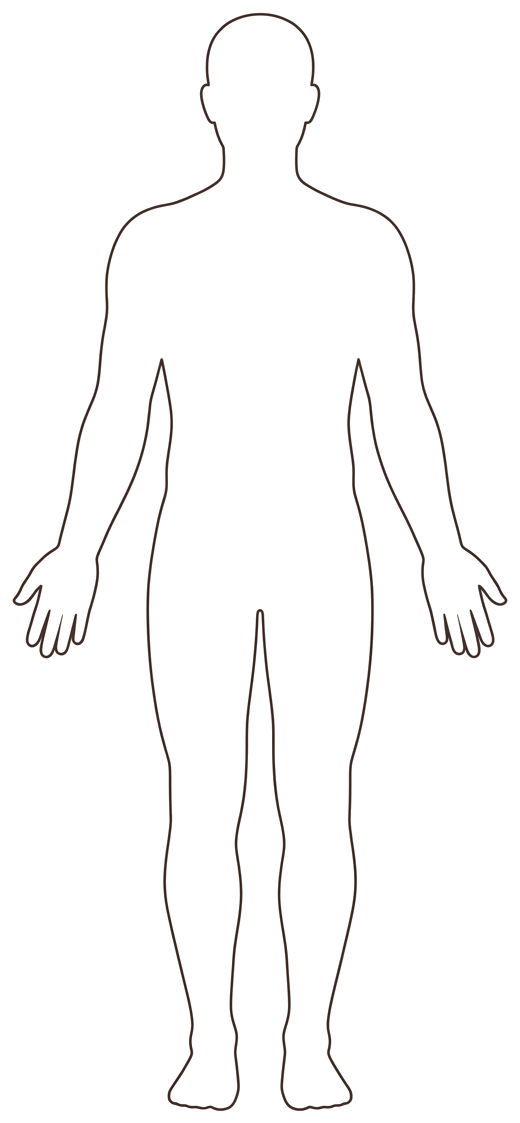
The easiest spots are the belly (about 2 inches either side of the navel), the love handles, the front of the thigh, and the back of the upper arms. Rotate every injection.
So which should a beginner pick? For essentially everyone, subcutaneous is the answer: absorption is reliable, the needle is tiny, and the small volume makes it simple. Intramuscular gains you nothing here, and oral does not work. Timing matters more than route: dose on an empty stomach, ideally before bed.
Reconstitution: mixing it.
Ipamorelin arrives as a dry powder, so before you can inject it you reconstitute it, which just means adding liquid to turn the powder into something you can draw into a syringe. It sounds technical but takes about a minute.
Once it is mixed, the only real question is how many units to draw. Because Ipamorelin is dosed in micrograms, getting the concentration right matters, and it is easy to get wrong by hand.
- Use bacteriostatic water, often called BAC water. The small amount of preservative keeps the mixed vial usable for weeks.
- Add the water slowly, down the inside wall of the vial. A common mix is a 5 mg vial plus 2.5 mL of BAC water, which gives a concentration of 2 mg/mL.
- Swirl, do not shake. Gently roll the vial until the powder dissolves. Shaking can damage the peptide.
- Store it in the fridge once mixed, and keep it out of direct light.
Open the dosage calculator to turn your vial and dose into an exact number of units. As a worked example: a 5 mg vial mixed with 2.5 mL of BAC water gives 2 mg/mL, so a 300 mcg dose is 0.15 mL, which is 15 units on a U-100 insulin syringe, and that vial holds about 16 doses.
Dosing by goal.
There is no single official dose for Ipamorelin, because it is not an approved medicine. What follows is the range people commonly run, organized by phase. The defining features of Ipamorelin dosing are micrograms, a bedtime empty-stomach shot, and gradual titration.
Starting out
Many people begin around 100 mcg once daily to see how they respond, then increase by roughly 50 mcg every week or two as tolerated. Starting low keeps water retention and head-rush feelings to a minimum while you find your level.
Standard daily dose
The most cited range is about 200 to 300 mcg once daily, given subcutaneously 30 to 45 minutes before bed on an empty stomach. Some people split it into two or three smaller doses across the day to chase more frequent pulses.
Stacked with CJC-1295
Ipamorelin is very often run alongside CJC-1295, a GHRH analog. The usual approach is a 1:1 ratio in micrograms, drawn into the same syringe, so CJC-1295 raises the baseline while Ipamorelin fires the pulse for a bigger combined GH release.
Begin low to gauge your response, then titrate up by about 50 mcg every week or two. This is the easing-in phase before your standard dose.
Once daily before bed on an empty stomach. Run in cycles of roughly 8 to 12 weeks, then a break, rather than indefinitely.
Cycling and timing.
A cycle just means a defined run of time on the peptide, followed by a break. For Ipamorelin the common pattern is daily dosing for roughly 8 to 12 weeks, then a 2 to 4 week pause to let the receptors resensitize, rather than running it indefinitely.
Why not just run it forever? Partly because the receptor can become less responsive over time, and partly because the long-term human safety data does not exist yet. The cautious and widely followed approach is a focused block, then time off.
- Hold the schedule through your cycle, once daily before bed, on an empty stomach, at roughly the same time.
- Take a real break of 2 to 4 weeks after a cycle to let the ghrelin receptor resensitize before starting another.
- Watch how you respond. If water retention or other effects build, ease the dose down rather than pushing through, and bring questions to a licensed provider.
Stacking Ipamorelin.
Ipamorelin is rarely run alone. It is one half of the most popular growth-hormone pairing in the whole peptide world.
Lean muscle & recovery
The classic GH stack. CJC-1295 is a GHRH analog that raises the baseline, while Ipamorelin fires the pulse through the ghrelin receptor. Together they produce a larger, more physiologic GH release than either alone, usually 1:1 in micrograms in one bedtime shot.
View stack →Body recomposition
A fat-loss leaning version that adds Tesamorelin, a GHRH studied specifically for visceral fat. People run it when leaning out is the priority while still supporting lean mass. More moving parts, so it suits people past the beginner stage.
View stack →See full recipes, dosing, and how people run them on the stacks page.
Side effects and safety.
In the reports we see, Ipamorelin is generally described as well tolerated, with a cleaner profile than most GH-releasing peptides. Side effects tend to be mild and temporary when they show up at all. The ones people mention most often are:
- Mild water retention, sometimes in the hands or face, which usually eases with a lower dose or less sodium.
- Head rush or lightheadedness shortly after a dose, especially early in a cycle.
- Injection-site irritation, a little redness or a small bump, which is why rotating sites matters.
- Increased appetite, headache, or temporary tiredness, tied to its action on the ghrelin receptor.
Who should be cautious.
Some people have clear reasons to be extra careful, or to avoid Ipamorelin entirely until they have spoken with a licensed provider.
- Pregnant or breastfeeding. There is no safety data here, so this is a hard avoid.
- A history of cancer, or active cancer. Because raising growth hormone and IGF-1 could in theory feed cell growth, caution is widely advised. This is a conversation for an oncologist, not a forum.
- Diabetes or blood-sugar issues. Growth hormone can affect insulin sensitivity, so anyone managing blood sugar should talk to a provider first.
- Competing athletes. Ipamorelin is banned by WADA and will show up as a prohibited substance.
And the universal one: whoever you are, talk to a licensed healthcare provider before starting Ipamorelin. This guide is educational, not a substitute for personalized medical advice.
Where to buy it safely.
This is where a lot of beginners get burned, because peptide quality varies wildly between vendors and the cheapest vial is not always the real deal. Our honest take: do not shop on price alone, shop on price plus independent lab data.
- Compare vendors side by side. Price ranges are wide, and the difference between the lowest and highest listing can be large for the exact same compound.
- Look for recent third-party lab tests. The gold standard the community looks for is a recent Janoshik certificate of analysis showing purity for the batch you are actually buying.
- Favor recent COAs. An old lab result on a different batch tells you little. The fresher the test, the more it means.
- Be skeptical of suspiciously cheap listings with no testing behind them.
That is exactly the comparison we put together. On our Ipamorelin product page you can compare vendor prices, see which batches have public lab data, and view the grades we assign from that data. From there you can head to the buy page to line up your options.
Questions, answered straight.
Is Ipamorelin legal?
Ipamorelin is not an approved drug and is not sold for human use. The vendors we compare offer it strictly for research use only. It is also on WADA's prohibited list as a growth-hormone secretagogue, so competing athletes should steer clear. Rules vary by country, so check what applies where you are.
How is it different from CJC-1295?
They work on different switches. CJC-1295 is a GHRH analog that raises the baseline drive for growth hormone, while Ipamorelin acts on the ghrelin receptor to fire a discrete pulse. They complement each other, which is why the two are stacked so often, usually 1:1 in micrograms.
How is it different from MK-677?
MK-677 is an oral GH secretagogue, so no needles, but it tends to cause more water retention and appetite increase and stays active far longer in the body. Ipamorelin is injected, shorter-acting, and cleaner, with a more natural pulse. Convenience versus a tidier profile.
Why before bed and on an empty stomach?
Most of your natural growth hormone is released during deep sleep, so a bedtime dose stacks with that nightly surge. Food, especially carbs and fat, raises insulin, which blunts the GH response, so people dose on an empty stomach, roughly 30 to 45 minutes before eating or sleeping.
How long until it works?
Effects build over weeks, not days. Many people notice sleep changes early, while recovery and body-composition shifts take a full cycle of 8 to 12 weeks to judge. It is not an overnight switch.
How do I figure out the dose in units?
Use our calculator. Enter your vial size, how much bacteriostatic water you added, and your target dose in micrograms, and it tells you exactly how many units to draw on a U-100 syringe. The dosage calculator handles the math for you.