The short version.
If you read nothing else, read this. The whole guide in a handful of bullets.
- What it is: KPV is a tiny three-amino-acid fragment of alpha-MSH, a hormone your body already makes. It carries the hormone's anti-inflammatory action without the skin-darkening part.
- What people run it for: calming inflammation, gut conditions, and skin flares, often as the anti-inflammatory layer stacked with BPC-157.
- Typical dose: about 200 to 500 mcg once daily by subcutaneous injection, or 250 to 500 mcg once or twice daily by mouth for gut issues.
- Routes: subcutaneous injection is the standard for skin and body-wide effects. Oral is popular for the gut. Topical creams exist for skin.
- Cycle: a focused block of roughly four to eight weeks during a flare, run in cycles rather than continuously.
- Honest caveat: there are no completed human clinical trials of KPV. The evidence is preclinical and community-based. It is sold for research use only, and this is not medical advice.
Quick reference.
| Typical dose | 200 to 500 mcg daily (subq), 250 to 500 mcg 1 to 2x daily (oral) |
|---|---|
| Routes | Subcutaneous injection (standard), oral for gut, topical for skin |
| Frequency | Once daily injected, once or twice daily oral |
| Cycle length | ~4 to 8 week block during a flare, in cycles |
| Best for | Gut inflammation, skin flares, body-wide inflammation |
What is KPV?
KPV is a peptide, which simply means a small chain of amino acids, the same building blocks that make up the proteins in your body. In this case the chain is about as short as it gets: just three amino acids, lysine, proline, and valine, which is where the name KPV comes from.
Those three amino acids are the tail end of a natural hormone called alpha-MSH. The full hormone does several things, including darkening skin pigment, but researchers found that this small tail carries most of the anti-inflammatory action and leaves the pigment effect behind. KPV is the lab-made version of that active piece.
The version sold by vendors arrives as a freeze-dried white powder in a small sealed vial. It is not a steroid, not a hormone in the usual sense, and not a stimulant. People reach for it for one theme above all: turning down inflammation, especially in the gut and the skin.
Worth saying plainly: KPV is not an approved medicine anywhere. It is sold strictly for research use only, and there are no completed human clinical trials. The most encouraging results come from animal models of gut inflammation. We get into what that means further down.
How it works in the body.
You do not need a biology degree to follow this. Here is the simple picture, then a little more for the curious.
The core idea is that KPV works like a brake on inflammation. Rather than building new tissue, it tells overactive immune cells to settle down through a few overlapping mechanisms that show up repeatedly in the research.
- Blocks the inflammation switch. KPV gets inside cells and blocks NF-kB, a master switch that turns on inflammatory genes. With that switch dialed down, the cell makes fewer signals like TNF-alpha, IL-6, and IL-8.
- Calms the gut lining directly. Inflamed gut tissue carries more of a transporter called PepT1, which pulls KPV straight into the cells that need it. That is why oral KPV is studied so much for gut inflammation: the inflamed tissue more or less self-targets it.
- Shifts immune cells toward repair. It is studied for nudging macrophages, a type of immune cell, away from their destructive mode and toward a calmer, reparative one, without broadly shutting the immune system down.
How to take it: routes of administration.
KPV is genuinely flexible on route, which sets it apart from a lot of peptides. The right choice depends on what you are targeting: the gut, the skin, or the whole body. Here is the honest comparison.
| Route | Typical dose | Absorption | Best for | Difficulty |
|---|---|---|---|---|
| Subcutaneous | 200 to 500 mcg | Reliable, systemic | Skin and body-wide inflammation | Tiny needle, easy to learn |
| Oral | 250 to 500 mcg | Local to gut, low systemic | Gut inflammation | No needles, self-targets inflamed gut |
| Topical | Varies | Local to skin | Localized skin flares | Cream or solution, no needles |
Subcutaneous injection
The standard route for skin and body-wide effects. A tiny insulin needle goes into the fat just under the skin, not into muscle. A simple subcutaneous shot into the belly delivers KPV throughout the body, and it is far less intimidating than it sounds.
Oral
The popular choice for gut conditions. Unusually for a peptide, KPV survives well enough that inflamed gut tissue absorbs it directly through the PepT1 transporter. Oral doses run a little higher than injected ones because whole-body absorption is lower, but for the gut that is the point.
Topical
For a specific patch of irritated or inflamed skin, some people use a KPV cream or solution applied right to the area. It keeps the effect local. Formulations vary a lot, so there is no single standard strength here.
Where to inject.
If you go this route, these are the sites people use. Rotate so no single area gets sore.
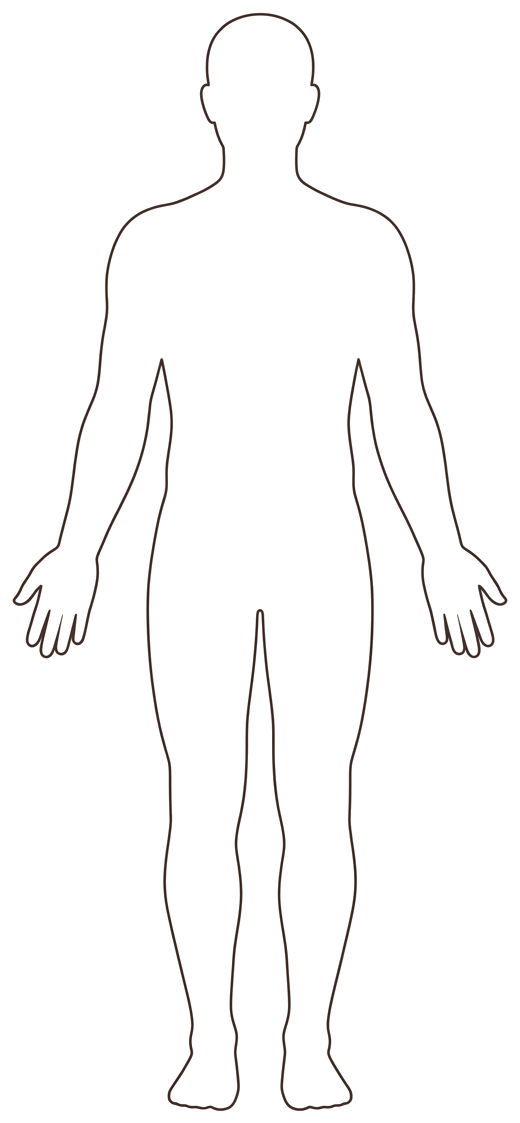
The easiest spots are the belly (about 2 inches either side of the navel), the love handles, the front of the thigh, and the back of the upper arms. Rotate every injection.
So which should a beginner pick? It depends entirely on the target. For gut issues, oral is the natural fit because the inflamed tissue pulls KPV in directly. For skin flares or whole-body inflammation, subcutaneous injection is the reliable standard. Topical is a niche option for one stubborn patch of skin.
Reconstitution: mixing it.
KPV arrives as a dry powder, so before you can inject it you reconstitute it, which just means adding liquid to turn the powder into something you can draw into a syringe. It sounds technical but takes about a minute.
Once it is mixed, the only real question is how many units to draw. That depends on your vial size, your water amount, and your target dose, and it is easy to get wrong by hand.
- Use bacteriostatic water, often called BAC water. The small amount of preservative keeps the mixed vial usable for weeks.
- Add the water slowly, down the inside wall of the vial. A common mix is a 5 mg vial plus 2 mL of BAC water, which gives a concentration of 2.5 mg/mL.
- Swirl, do not shake. Gently roll the vial until the powder dissolves. Shaking can damage the peptide.
- Store it in the fridge once mixed, and keep it out of direct light.
Open the dosage calculator to turn your vial and dose into an exact number of units. As a worked example: a 5 mg vial mixed with 2 mL of BAC water gives 2.5 mg/mL, so a 0.5 mg (500 mcg) dose is 0.2 mL, which is 20 units on a U-100 insulin syringe, and that vial holds about 10 doses.
Dosing by goal.
There is no single official dose for KPV, because it is not an approved medicine and no human trial has set one. What follows is the range people commonly run, organized by route. The doses are small, measured in micrograms.
Subcutaneous dosing
For skin or body-wide inflammation, the common pattern is about 200 to 500 mcg once a day, injected into the fat of the belly. People tend to start at the low end and adjust during a focused block of a few weeks.
Oral dosing
For gut conditions, oral KPV is often run a touch higher, around 250 to 500 mcg once or twice a day, usually on an empty stomach. The higher number reflects that less of an oral dose reaches the bloodstream, though for the gut the local effect is what matters.
Stacked with BPC-157
KPV is very often run alongside BPC-157, with KPV calming inflammation and BPC-157 working on the gut lining and soft tissue. Each keeps its own schedule, but they are run in the same block during a flare or recovery push.
Once-daily shot into the belly for skin flares or body-wide inflammation. Start low and adjust.
By mouth on an empty stomach for gut conditions. Run a little higher because whole-body absorption is lower.
Cycling and timing.
A cycle just means a defined run of time on the peptide, followed by a break. For KPV the common pattern is a focused block of roughly four to eight weeks during a flare or recovery push, then time off, rather than running it indefinitely.
Why not just run it forever? Mostly because the long-term human safety data does not exist yet. The cautious and widely followed approach is to run a focused block while you are settling inflammation, then stop.
- Hold a steady daily schedule through your block, dosing at roughly the same time each day.
- Match the route to the target, oral for the gut, subcutaneous for skin or whole-body inflammation.
- Take a real break after a cycle before considering another. If symptoms return, that is a conversation for a licensed provider.
Stacking KPV.
KPV is rarely the whole plan on its own. It is usually the anti-inflammatory layer that other repair peptides are built around.
Gut & inflammation
The gut-and-flare pairing. KPV calms the inflammatory signaling while BPC-157 works on the gut lining and soft tissue. The logic people use is simple: KPV puts out the fire, BPC-157 helps rebuild. The combination people reach for during a flare.
View stack →Full recovery cascade
The all-in-one healing blend. It layers tissue and tendon repair, gut and skin support, and calmer inflammation into one protocol, with KPV supplying the anti-inflammatory piece. A popular step up for people who want to cover the whole recovery picture at once.
View stack →See full recipes, dosing, and how people run them on the stacks page.
Side effects and safety.
In the reports we see, KPV is generally described as well tolerated, with side effects that tend to be mild and temporary when they show up at all. The ones people mention most often are:
- Injection-site irritation, a little redness or a small bump, which is why rotating sites matters.
- Mild, brief GI changes, occasionally reported with the oral form.
- Headache or tiredness, sometimes mentioned in the first days of a cycle.
- Nothing serious in the animal data, where colitis-model studies reported no toxicity at the doses tested.
Who should be cautious.
Some people have clear reasons to be extra careful, or to avoid KPV entirely until they have spoken with a licensed provider.
- Pregnant or breastfeeding. There is no safety data here, so this is a hard avoid.
- Active autoimmune disease or immune suppression. Because KPV acts on inflammatory and immune signaling, anyone managing an immune condition should loop in their provider first.
- Competing athletes. KPV is not specifically named by WADA, but anti-inflammatory peptides sit in a gray area, so check current rules before competing.
- Anyone on other medications. If you take prescription drugs or manage a chronic condition, talk to your provider first.
And the universal one: whoever you are, talk to a licensed healthcare provider before starting KPV. This guide is educational, not a substitute for personalized medical advice.
Where to buy it safely.
This is where a lot of beginners get burned, because peptide quality varies wildly between vendors and the cheapest vial is not always the real deal. Our honest take: do not shop on price alone, shop on price plus independent lab data.
- Compare vendors side by side. Price ranges are wide, and the difference between the lowest and highest listing can be large for the exact same compound.
- Look for recent third-party lab tests. The gold standard the community looks for is a recent Janoshik certificate of analysis showing purity for the batch you are actually buying.
- Favor recent COAs. An old lab result on a different batch tells you little. The fresher the test, the more it means.
- Be skeptical of suspiciously cheap listings with no testing behind them.
That is exactly the comparison we put together. On our KPV product page you can compare vendor prices, see which batches have public lab data, and view the grades we assign from that data. From there you can head to the buy page to line up your options.
Questions, answered straight.
Is KPV legal?
KPV is not an approved drug and is not sold for human use. The vendors we compare offer it strictly for research use only. It is not specifically named on WADA's prohibited list, but anti-inflammatory peptides sit in a gray area, so competing athletes should be cautious. Rules vary by country, so check what applies where you are.
Is KPV the same as alpha-MSH?
Not quite. KPV is the three-amino-acid tail of the full alpha-MSH hormone. It keeps the anti-inflammatory action but leaves behind the pigment-darkening effect of the full molecule, which is exactly why researchers got interested in this small fragment.
Should I take it orally or inject it?
It depends on the target. For gut conditions, oral KPV is popular because inflamed gut tissue absorbs it directly. For skin flares or body-wide inflammation, people inject it subcutaneously into the belly. Some use a topical cream for one patch of skin. There is no official dose for any route, so start low.
How is it different from BPC-157?
They do different jobs and are often run together. BPC-157 is studied mostly for repairing the gut lining and soft tissue. KPV is studied for calming inflammation. People stack them so the inflammation comes down while the tissue rebuilds.
How long until it works?
Reports vary. For an active flare some people describe a settling within days to a couple of weeks, while others run a full multi-week block before judging it. Because the human evidence is thin, treat timelines as rough rather than reliable.
Does it need refrigeration?
Keep the sealed, freeze-dried vial in the fridge and out of light. Once you mix it with bacteriostatic water, store it refrigerated and use it within a few weeks. Do not freeze a reconstituted vial.
How do I figure out the dose in units?
Use our calculator. Enter your vial size, how much bacteriostatic water you added, and your target dose, and it tells you exactly how many units to draw on a U-100 syringe. The dosage calculator handles the math for you.