The short version.
If you read nothing else, read this. The whole guide in a handful of bullets.
- What it is: Thymalin is a peptide extract of the thymus gland. It is one of the original peptide bioregulators from Russian research, used to nudge the immune system back toward balance.
- What people run it for: immune restoration, fewer infections, and as part of a healthy-aging routine, very often paired with Epitalon.
- Typical dose: about 5 to 10 mg daily by injection, given as a short course of 5 to 10 days.
- Routes: intramuscular injection is the traditional clinical route. Some people use subcutaneous as a gentler alternative. It is not an oral peptide.
- Cycle: short defined courses, repeated once or twice a year, rather than continuous daily use.
- Honest caveat: most evidence comes from Russian clinical research and animal studies that have not been replicated in large independent Western trials. It is sold for research use only, and this is not medical advice.
Quick reference.
| Typical dose | 5 to 10 mg daily, in short courses |
|---|---|
| Routes | Intramuscular injection (standard), subcutaneous alternative |
| Frequency | Daily during a course of 5 to 10 days |
| Cycle length | Short courses, repeated once or twice a year |
| Best for | Immune restoration, healthy aging, longevity routines |
What is Thymalin?
Thymalin is a peptide bioregulator, which means a small mix of peptides, the building blocks that make up proteins, drawn from an organ and used to signal to that same system in the body. It is extracted from the thymus, the gland that trains your immune cells, especially T-cells, early in life.
The thymus shrinks and slows down as you age, which is part of why immune function declines over time. The thinking behind Thymalin is that feeding the body a concentrated set of thymic peptides can help an aging or off-balance immune system behave more like a younger one.
The version sold by vendors arrives as a freeze-dried white powder in a small sealed vial. It is not a steroid, not a hormone, and not a stimulant. It comes out of a long line of Russian research led by Vladimir Khavinson, who studied short peptide courses for immune health and longevity from the 1980s onward.
Worth saying plainly: Thymalin is not an approved medicine in the US. It is sold strictly for research use only, and most of the supporting evidence comes from older Russian clinical work and animal studies that have not been confirmed in large independent Western trials. We get into what that means further down.
How it works in the body.
You do not need a biology degree to follow this. Here is the simple picture, then a little more for the curious.
The core idea is that Thymalin works as a bioregulator, meaning it is studied for helping an immune system find its own balance rather than just forcing one response up or down. It is thought to do this through a few overlapping mechanisms that show up in the research.
- T-cell maturation. Thymalin is studied for helping immature immune cells finish maturing into working T-lymphocytes, the cells that coordinate much of your defense, which is the thymus's original job.
- Rebalancing, not just boosting. Rather than pushing the immune system in one direction, it is described as restoring a healthier ratio of immune cell types, calming an overactive response or lifting an underactive one.
- Gene-level signaling. Khavinson's group proposed that these short peptides act at the gene level, which is the explanation offered for why a brief course is thought to produce effects that outlast the injections themselves.
How to take it: routes of administration.
Thymalin is an injectable peptide. It is not a meaningful oral option, so the real choice is intramuscular versus subcutaneous. Here is the honest comparison.
| Route | Typical dose | Absorption | Best for | Difficulty |
|---|---|---|---|---|
| Intramuscular | 5 to 10 mg | High, traditional | Clinical-style courses | The standard route in the research |
| Subcutaneous | 5 to 10 mg | Reliable | A gentler self-inject option | Smaller needle, easier to learn |
| Oral | Not practical | Very low | Not recommended | Poorly absorbed |
Intramuscular injection
The route used throughout the original clinical research. The needle goes into muscle, usually the upper outer buttock or the outer thigh, using the Z-track method. It is a bit more involved than a subcutaneous shot, which is why some people prefer the alternative below.
Subcutaneous
Some people use subcutaneous injection into the fat just under the skin as a gentler, easier alternative to intramuscular. A tiny insulin needle is far less intimidating, and after reconstitution it is the same draw. The classic protocols used IM, so treat subq as the convenience option.
Oral
Thymalin is not a practical oral peptide. As a peptide mix it does not survive digestion well, so capsule versions are not worth chasing. Stick to the injectable form for the protocols people actually run.
Where to inject.
If you go this route, these are the sites people use. Rotate so no single area gets sore.
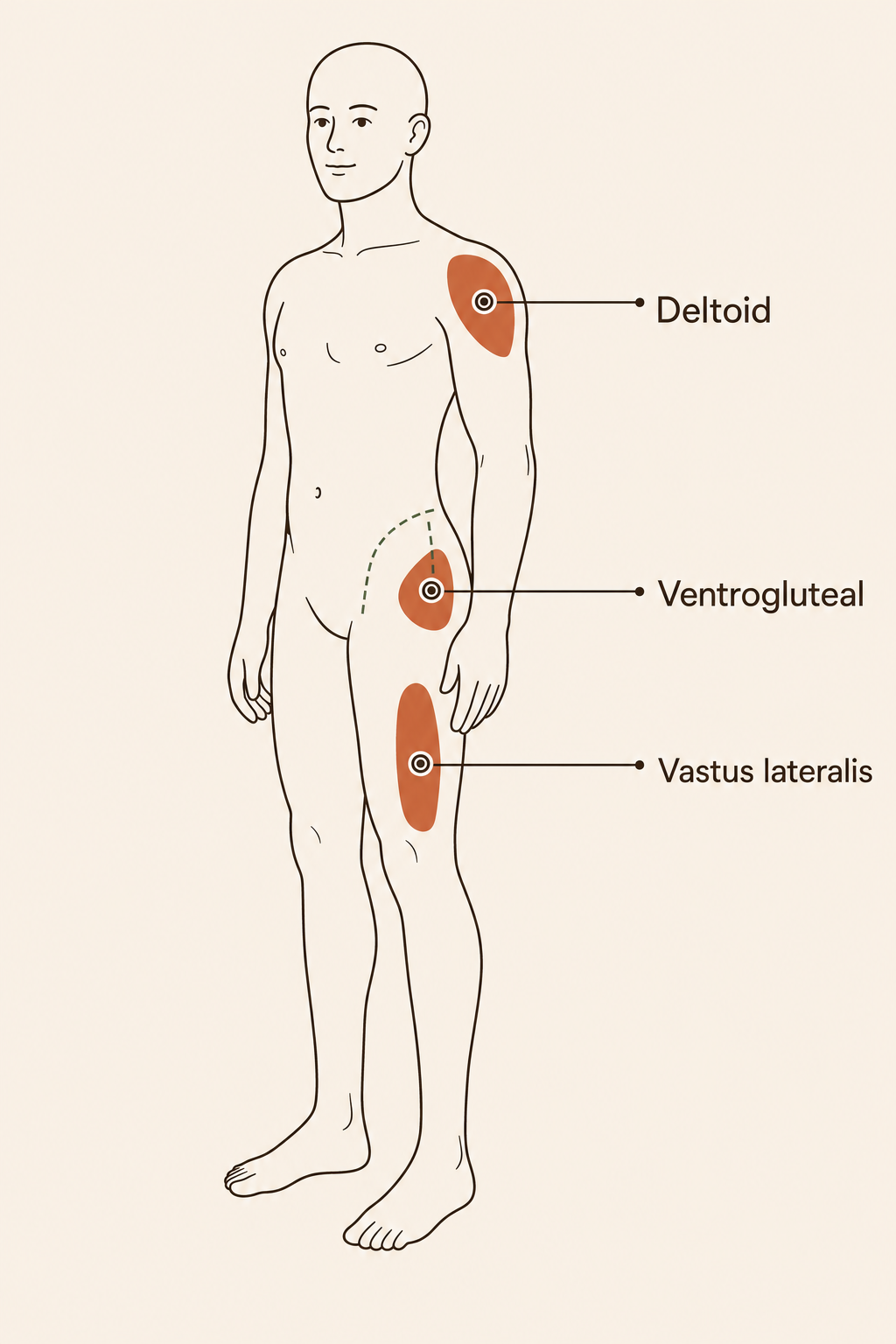
Inject into muscle: the shoulder (deltoid), the hip (ventrogluteal), or the outer thigh (vastus lateralis). Rotate every injection.
So which should a beginner pick? Intramuscular is what the research used and what most protocols specify, so it is the traditional answer. Subcutaneous is a reasonable, gentler alternative if you are more comfortable with a small insulin needle. Oral is not worth pursuing.
Reconstitution: mixing it.
Thymalin arrives as a dry powder, so before you can inject it you reconstitute it, which just means adding liquid to turn the powder into something you can draw into a syringe. It sounds technical but takes about a minute.
Once it is mixed, the only real question is how many units to draw. That depends on your vial size, your water amount, and your target dose, and it is easy to get wrong by hand. One quirk with Thymalin: people often mix it fresh each day, since the reconstituted solution is not meant to sit around for weeks.
- Use bacteriostatic water, often called BAC water. The small amount of preservative keeps a mixed vial usable, though with Thymalin many people mix only what they will use that day.
- Add the water slowly, down the inside wall of the vial. A common mix is a 10 mg vial plus 1 mL of BAC water, which gives a concentration of 10 mg/mL.
- Swirl, do not shake. Gently roll the vial until the powder dissolves. Shaking can damage the peptide.
- Use it fresh and keep the rest cold. Reconstituted Thymalin is best used promptly; store sealed vials and any mixed solution in the fridge, out of direct light.
Open the dosage calculator to turn your vial and dose into an exact number of units. As a worked example: a 10 mg vial mixed with 1 mL of BAC water gives 10 mg/mL, so a 10 mg dose is 1 mL, which is 100 units on a U-100 insulin syringe. A 5 mg dose is 50 units, so that vial would cover two of the lower doses.
Dosing by goal.
There is no single official dose for Thymalin, because it is not an approved medicine in the US. What follows is the range used in the research and run by the community, organized by use. The defining feature of Thymalin dosing is the short-course structure.
Standard course
The most common pattern is about 5 to 10 mg daily for a short course of 5 to 10 days, then stopping. Lower doses over fewer days are used for lighter, preventive goals; higher doses over more days for a stronger immune focus.
Repeat courses
Rather than running it continuously, people repeat the short course once or twice a year. The theory behind the bioregulator approach is that a brief course can produce effects that carry on after you stop, so you are not meant to dose it every day forever.
Paired with Epitalon
In the classic Khavinson longevity routine, Thymalin is run alongside Epitalon, often as parallel 10-day courses. The two are on the same daily rhythm during the block but target different systems, immune and pineal.
Daily injections for a short course of 5 to 10 days, then stop. This is the core protocol, not an ongoing daily dose.
Repeat the same short course once or twice a year. Thymalin is run in defined courses, not indefinitely.
Cycling and timing.
A cycle just means a defined run of time on the peptide, followed by a break. For Thymalin the pattern is built in: a short course of daily injections over 5 to 10 days, then off, with the course repeated once or twice a year rather than run continuously.
Why not just run it forever? Partly because the whole bioregulator idea is that a brief course is enough, and partly because the long-term human safety data outside the original Russian work is thin. The cautious, widely followed approach is the short repeated course.
- Run the full course of daily injections over your chosen 5 to 10 days at roughly the same time each day.
- Stop at the end of the course rather than drifting into open-ended daily use. The course is the unit, not the single dose.
- Space out repeats to once or twice a year. If you are using it for a specific health reason, that is a conversation for a licensed provider.
Stacking Thymalin.
Thymalin is often run as part of a healthy-aging routine rather than alone. The most famous pairing comes straight out of the longevity research.
Immune & longevity
The classic bioregulator pairing from the longevity research. Thymalin works on the immune system through the thymus, while Epitalon works on the pineal side. They are run as parallel short courses in the same block, the combination most associated with the original mortality studies.
View stack →Healthy aging
A longevity-leaning step up that layers immune balance, the pineal bioregulator, and a mitochondrial peptide. An ambitious routine for people focused on the aging picture as a whole rather than one system.
View stack →See full recipes, dosing, and how people run them on the stacks page.
Side effects and safety.
In the reports we see, and in its long clinical history, Thymalin is generally described as well tolerated, with side effects that tend to be mild and temporary when they show up at all. The ones people mention most often are:
- Injection-site irritation, a little redness or soreness, which is why rotating sides and using clean technique matters.
- Mild fatigue in the first few days of a course.
- Occasional headache or nausea, often linked to dehydration or rushed injection rather than the peptide itself.
- Rare allergic-type reactions, as with any injected biological extract.
Who should be cautious.
Some people have clear reasons to be extra careful, or to avoid Thymalin entirely until they have spoken with a licensed provider.
- Pregnant or breastfeeding. There is no safety data here, so this is a hard avoid.
- Active cancer or a history of cancer. Because Thymalin acts on the immune system, anyone with a cancer history should treat this as a conversation for an oncologist, not a forum.
- Autoimmune conditions or immunosuppressive medication. A peptide that nudges the immune system can interact with these in ways that need a provider's input.
- Anyone on other medications. If you take prescription drugs or manage a chronic condition, talk to your provider first.
And the universal one: whoever you are, talk to a licensed healthcare provider before starting Thymalin. This guide is educational, not a substitute for personalized medical advice.
Where to buy it safely.
This is where a lot of beginners get burned, because peptide quality varies wildly between vendors and the cheapest vial is not always the real deal. Our honest take: do not shop on price alone, shop on price plus independent lab data.
- Compare vendors side by side. Price ranges are wide, and the difference between the lowest and highest listing can be large for the exact same compound.
- Look for recent third-party lab tests. The gold standard the community looks for is a recent Janoshik certificate of analysis showing purity for the batch you are actually buying.
- Favor recent COAs. An old lab result on a different batch tells you little. The fresher the test, the more it means. This matters extra for an extract like Thymalin, where consistency between batches is a fair question.
- Be skeptical of suspiciously cheap listings with no testing behind them.
That is exactly the comparison we put together. On our Thymalin product page you can compare vendor prices, see which batches have public lab data, and view the grades we assign from that data. From there you can head to the buy page to line up your options.
Questions, answered straight.
Is Thymalin legal?
Thymalin is not an approved drug in the US and is not sold for human use here. The vendors we compare offer it strictly for research use only. It has a long clinical history in Russia and CIS countries. It is not currently on WADA's prohibited list, but policies change, so competing athletes should verify before relying on that. Rules vary by country, so check what applies where you are.
Is Thymalin the same as Thymosin α-1?
Not quite. Thymalin is an older bioregulator, a mix of peptides extracted from the thymus, while Thymosin alpha-1 is a single, defined synthetic peptide. They are both thymus-derived and both run for immune support, but they are different products with different evidence bases.
How is it different from Epitalon?
Epitalon is the pineal-gland bioregulator from the same Russian research lineage; Thymalin is the thymus, or immune, side. They are run together so often in longevity routines that the pair is closely associated with the original mortality studies. They target different systems but share the short-course philosophy.
How long until it works?
Because Thymalin is run as a short course aimed at lasting change, effects are judged over weeks and months rather than the day of a dose. It is not an overnight switch, and the bioregulator theory is that benefits carry on after the course ends.
Intramuscular or subcutaneous?
Intramuscular is the traditional clinical route and what the research used. Some people use subcutaneous as a gentler, easier alternative. After reconstitution the draw is the same either way. Thymalin is not an oral peptide, so skip any capsule versions.
Does it need refrigeration?
Keep the sealed, freeze-dried vials in the fridge and out of light. Thymalin is usually reconstituted fresh and used promptly rather than stored mixed for weeks, so only mix what you plan to inject. Use our dosage calculator to work out your units.