The short version.
If you read nothing else, read this. The whole guide in a handful of bullets.
- What it is: Epitalon is a synthetic copy of Epithalamin, a four-amino-acid peptide from the pineal gland. It is the lab-made version of a natural body-clock signal.
- What people run it for: longevity and healthspan, telomere maintenance, better sleep, and restoring a more youthful circadian rhythm, usually as short seasonal courses.
- Typical dose: about 5 to 10 mg per day for a course of 10 to 20 consecutive days, repeated two or three times a year.
- Routes: subcutaneous injection is the standard, the route used in nearly all published research. It is not a meaningful oral peptide.
- Cycle: a short daily course of 10 to 20 days, then months off, run seasonally rather than continuously.
- Honest caveat: most of the telomerase and lifespan evidence comes from one Russian research group, in animals and small uncontrolled human studies. It is sold for research use only, and this is not medical advice.
Quick reference.
| Typical dose | 5 to 10 mg per day for 10 to 20 days |
|---|---|
| Routes | Subcutaneous injection (standard) |
| Frequency | Daily during a short course, evening common |
| Cycle length | 10 to 20 day course, then 4 to 6 months off |
| Best for | Longevity, telomere maintenance, sleep and circadian rhythm |
What is Epitalon?
Epitalon is a short peptide, which simply means a small chain of amino acids, the same building blocks that make up the proteins in your body. It is built from just four amino acids, which makes it one of the smallest peptides people run. It is a synthetic copy of a natural peptide called Epithalamin, which comes from the pineal gland deep in the brain.
The pineal gland is best known for making melatonin and helping run the body's master clock. As we age, that gland becomes less active. Researchers, led by the Russian gerontologist Vladimir Khavinson, isolated the peptide signal from this gland and made a synthetic version, which is the Epitalon sold today.
The version sold by vendors arrives as a freeze-dried white powder in a small sealed vial. It is not a steroid, not a hormone, and not a stimulant. People reach for it because it is studied for one big theme above all: slowing aspects of aging by maintaining telomeres, the protective caps on the ends of your chromosomes, and by restoring a more youthful body-clock rhythm.
Worth saying plainly: Epitalon is not an approved medicine anywhere. It is sold strictly for research use only, and the great majority of the longevity and telomerase research comes from a single research group in St. Petersburg, in animals, cell cultures, and small uncontrolled human studies. We get into what that means further down.
How it works in the body.
You do not need a biology degree to follow this. Here is the simple picture, then a little more for the curious.
The core idea is that Epitalon is studied for working on two systems at once: the telomeres that protect your DNA, and the pineal gland that runs your body clock. It does this through a few overlapping mechanisms that show up repeatedly in the research.
- Telomerase activation. Every time a cell divides, its telomeres get a little shorter, and very short telomeres push cells toward aging. Epitalon is studied for switching on telomerase, the enzyme that rebuilds telomeres, which in lab studies extended telomere length in human cells.
- Pineal and melatonin support. It is studied for nudging the pineal gland back toward a more youthful melatonin rhythm, which is part of why people associate it with better sleep and a healthier body clock.
- Antioxidant and gene-signaling effects. Animal work also links it to lower oxidative stress and changes in gene activity tied to aging, though these effects are harder to feel and far harder to verify in people.
How to take it: routes of administration.
Epitalon is an injectable peptide. Nearly all of the published research used subcutaneous injection, and it is not a meaningful oral option, so the real choice is really just how you run the course. Here is the honest comparison.
| Route | Typical dose | Absorption | Best for | Difficulty |
|---|---|---|---|---|
| Subcutaneous | 5 to 10 mg | Reliable, systemic | The standard course | Tiny needle, easy to learn |
| Intramuscular | 5 to 10 mg | High, systemic | Occasionally used in studies | More invasive, not needed |
| Oral | Not practical | Very low | Not recommended | Poorly absorbed |
Subcutaneous injection
The standard route by far, and the one used in nearly all of the published Epitalon research. A tiny insulin needle goes into the fat just under the skin, not into muscle. It is far less intimidating than it sounds, and a simple belly shot works well.
Intramuscular
Some of the older research used intramuscular injection. The needle goes deeper and it is a bit more uncomfortable, with no clear advantage for most people. After reconstitution it is the same draw as a subcutaneous shot.
Oral
Epitalon is not a practical oral peptide. It is a small molecule that does not survive digestion in a useful way, so the capsule and oral-spray versions are not worth chasing. Stick to the injectable form.
Where to inject.
If you go this route, these are the sites people use. Rotate so no single area gets sore.
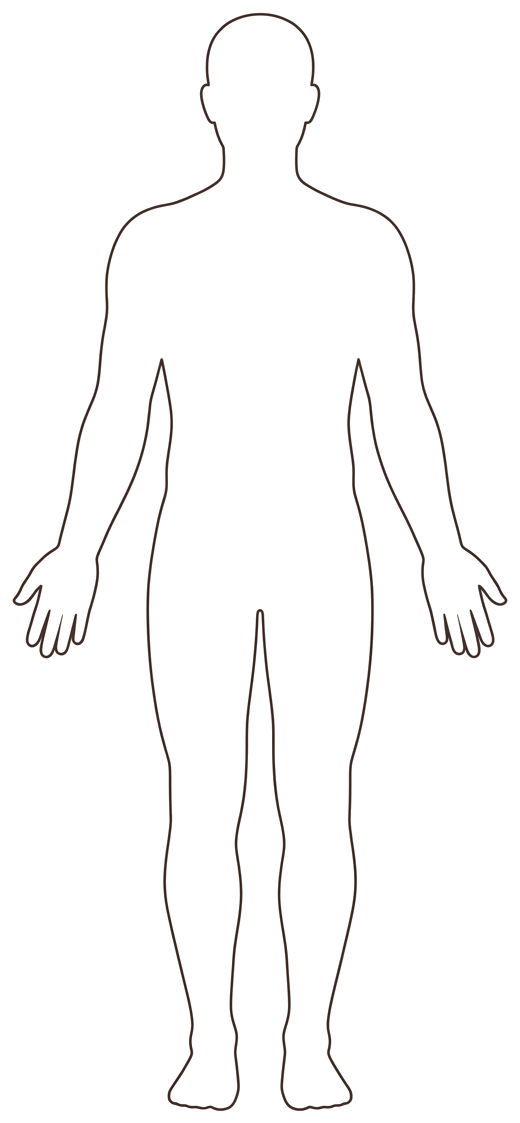
The easiest spots are the belly (about 2 inches either side of the navel), the love handles, the front of the thigh, and the back of the upper arms. Rotate every injection.
So which should a beginner pick? For almost everyone, subcutaneous is the answer: it matches how the research was done, absorption is reliable, and the needle is tiny. Intramuscular offers no real benefit here, and oral is not worth chasing.
Reconstitution: mixing it.
Epitalon arrives as a dry powder, so before you can inject it you reconstitute it, which just means adding liquid to turn the powder into something you can draw into a syringe. It sounds technical but takes about a minute.
Once it is mixed, the only real question is how many units to draw. That depends on your vial size, your water amount, and your target dose, and it is easy to get wrong by hand.
- Use bacteriostatic water, often called BAC water. The small amount of preservative keeps the mixed vial usable for weeks.
- Add the water slowly, down the inside wall of the vial. A common mix is a 10 mg vial plus 2 mL of BAC water, which gives a concentration of 5 mg/mL.
- Swirl, do not shake. Gently roll the vial until the powder dissolves. Shaking can damage the peptide.
- Store it in the fridge once mixed, and keep it out of direct light.
Open the dosage calculator to turn your vial and dose into an exact number of units. As a worked example: a 10 mg vial mixed with 2 mL of BAC water gives 5 mg/mL, so a 5 mg dose is 1 mL, which is 100 units on a U-100 insulin syringe, and that vial holds about 2 doses.
Dosing by goal.
There is no single official dose for Epitalon, because it is not an approved medicine. What follows is the range people commonly run, organized by how the course is structured. The defining feature of Epitalon dosing is the short daily course followed by months off.
The standard course
The most common pattern is about 5 to 10 mg per day, by subcutaneous injection, for a course of 10 to 20 consecutive days. A 10 day course at the higher dose and a 20 day course at the lower dose are both widely reported.
Seasonal repeats
Rather than running it continuously, people repeat the short course two or three times a year, spaced roughly four to six months apart. The idea borrowed from the research is periodic restoration, not a constant presence in the body.
Evening timing
Because Epitalon is tied to the pineal gland and melatonin, many people dose in the evening, often 30 to 60 minutes before bed, to line the peptide up with the body's natural night-time rhythm.
Daily dosing for a short window. Higher doses tend to run for fewer days, lower doses for more. This is the active phase.
Take a long break of roughly four to six months, then repeat. Epitalon is run as seasonal courses, not indefinitely.
Cycling and timing.
A cycle just means a defined run of time on the peptide, followed by a break. For Epitalon the common pattern is a short daily course of 10 to 20 days, then months off, then repeating the course seasonally, rather than running it indefinitely.
Why not just run it forever? Mostly because the long-term human safety data does not exist yet, and because the research itself used short periodic courses. The cautious and widely followed approach is to run a focused course, then stop for several months.
- Hold the daily schedule through your course, every day for the full 10 to 20 days, ideally at a consistent evening time.
- Then stop fully for several months. There is no taper; the course simply ends.
- Repeat seasonally if you choose, two or three times a year. If you have health concerns, that is a conversation for a licensed provider.
Stacking Epitalon.
Epitalon is often run as the telomere piece of a broader longevity protocol, alongside peptides that target different parts of cellular aging.
Telomeres & mitochondria
The popular three-angle longevity stack. Epitalon covers telomeres, MOTS-c targets mitochondrial signaling, and NAD+ supports cellular energy. People run these as separate but overlapping seasonal courses rather than one shot.
View stack →Anti-aging blend
A popular cosmetic longevity pairing. GHK-Cu adds the copper-peptide angle for skin, collagen, and gene-expression reset, layered on top of Epitalon's telomere and body-clock focus.
View stack →See full recipes, dosing, and how people run them on the stacks page.
Side effects and safety.
In the reports we see, Epitalon is generally described as well tolerated, with side effects that tend to be mild and temporary when they show up at all. The ones people mention most often are:
- Injection-site irritation, a little redness or a small bump, which is why rotating sites matters.
- Mild headache or dizziness, sometimes reported in the first days of a course.
- Drowsiness, which makes sense given the melatonin connection and is part of why people dose in the evening.
- Occasional nausea or fatigue, usually short-lived.
Who should be cautious.
Some people have clear reasons to be extra careful, or to avoid Epitalon entirely until they have spoken with a licensed provider.
- Pregnant or breastfeeding. There is no safety data here, so this is a hard avoid.
- A history of cancer, or active cancer. Because Epitalon is studied for activating telomerase, which cancer cells also rely on to keep dividing, caution is widely advised. This is a conversation for an oncologist, not a forum.
- Anyone on other medications. If you take prescription drugs or manage a chronic condition, talk to your provider first.
- Competing athletes. Epitalon is not currently named on WADA's list, but anti-aging compounds sit in a gray zone, so check your sport's rules before using it.
And the universal one: whoever you are, talk to a licensed healthcare provider before starting Epitalon. This guide is educational, not a substitute for personalized medical advice.
Where to buy it safely.
This is where a lot of beginners get burned, because peptide quality varies wildly between vendors and the cheapest vial is not always the real deal. Our honest take: do not shop on price alone, shop on price plus independent lab data.
- Compare vendors side by side. Price ranges are wide, and the difference between the lowest and highest listing can be large for the exact same compound.
- Look for recent third-party lab tests. The gold standard the community looks for is a recent Janoshik certificate of analysis showing purity for the batch you are actually buying.
- Favor recent COAs. An old lab result on a different batch tells you little. The fresher the test, the more it means.
- Be skeptical of suspiciously cheap listings with no testing behind them.
That is exactly the comparison we put together. On our Epitalon product page you can compare vendor prices, see which batches have public lab data, and view the grades we assign from that data. From there you can head to the buy page to line up your options.
Questions, answered straight.
Is Epitalon legal?
Epitalon is not an approved drug and is not sold for human use. The vendors we compare offer it strictly for research use only. It is not currently named on WADA's prohibited list, but anti-aging compounds sit in a gray zone, so competing athletes should check carefully. Rules vary by country, so check what applies where you are.
Does Epitalon really extend telomeres?
In lab and cell studies it is associated with switching on telomerase and lengthening telomeres in human cells. Whether that translates into a longer or healthier life in people is not proven. The human data is small, uncontrolled, and mostly from one research group, so treat the bold longevity claims with healthy skepticism.
How is it different from other longevity peptides?
Epitalon works on telomeres and the body clock, MOTS-c and SS-31 work on mitochondria, and NAD+ supports cellular energy. They target different parts of aging, which is why people stack them rather than picking just one. Epitalon's signature angle is the telomere and melatonin connection.
How long until it works?
Better sleep is the effect people most often notice during a course, sometimes within days. The deeper longevity claims, if real, would build over years and are not something you can feel. Many people simply run the seasonal courses and track sleep and how rested they feel.
Does it need refrigeration?
Keep the sealed, freeze-dried vial cold, in the fridge or freezer, and out of light. Once you mix it with bacteriostatic water, store it refrigerated and use it within a few weeks. Do not freeze a reconstituted vial.
How do I figure out the dose in units?
Use our calculator. Enter your vial size, how much bacteriostatic water you added, and your target dose, and it tells you exactly how many units to draw on a U-100 syringe. The dosage calculator handles the math for you.