MOTS-c
A 16-amino-acid peptide your own mitochondria make. People run it as an exercise mimetic, for metabolic health, insulin sensitivity, and fat oxidation, and as part of a longevity stack, usually alongside SS-31 or NAD+.
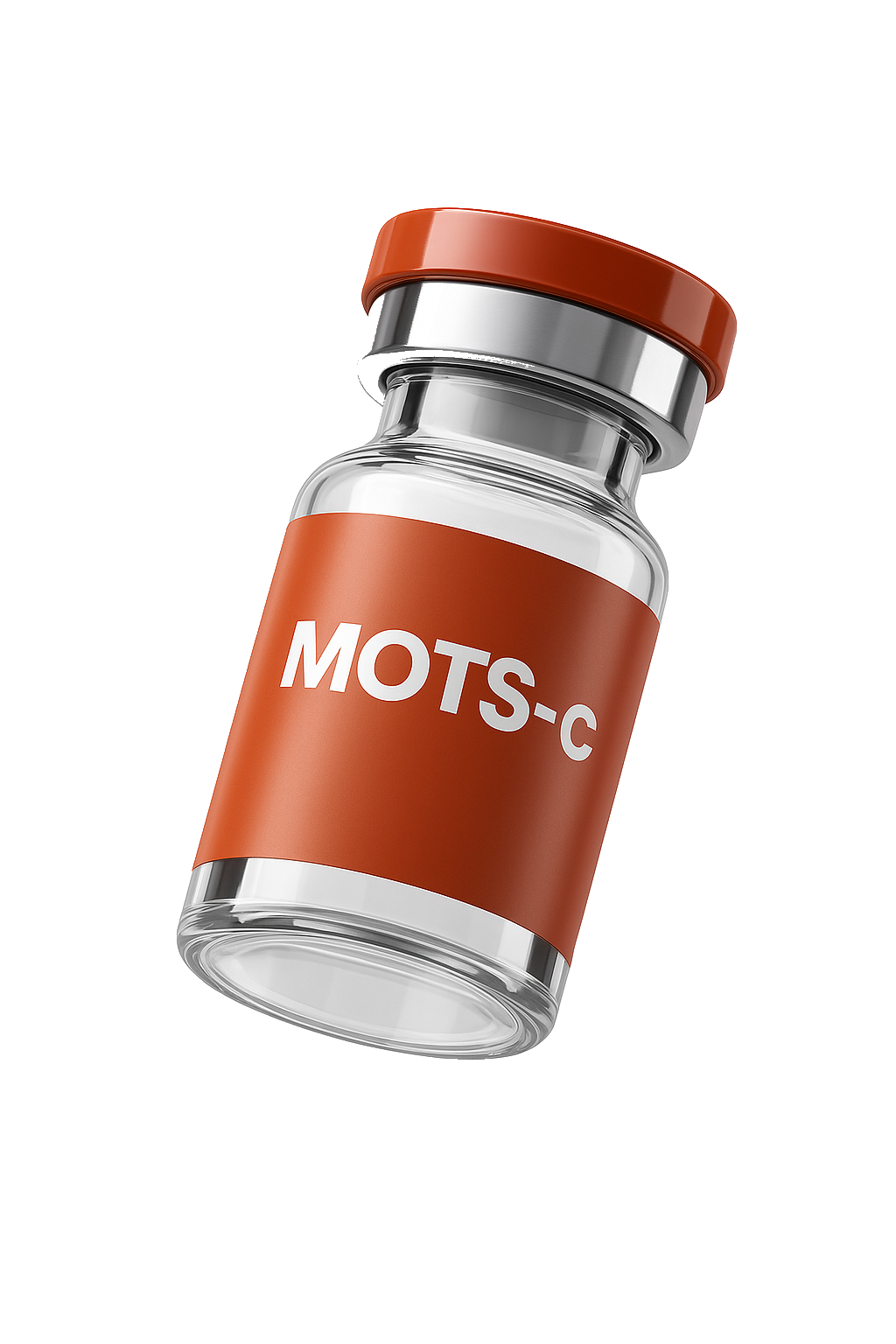
Where to buy MOTS-c, cheapest first.
Prices from 10 vendors across the market. We link straight to each vendor’s product page and grade vendors on public lab data, so you’re not just chasing the lowest number.
MOTS-c
What MOTS-c actually does.
The simple version first, then a little more for the curious. No biochem degree required.
It flips on AMPK, the cell's main energy switch, the same one your muscles use during exercise, so cells burn fat, take up glucose, and build more mitochondria.
How it works
MOTS-c is encoded inside your mitochondrial DNA. It moves to the cell nucleus under metabolic stress and activates AMPK, the master energy sensor, which shifts cells toward burning fuel, improving insulin sensitivity, and building new mitochondria.
Where it acts
It works body-wide at the cellular energy level, with the clearest signals in skeletal muscle, fat, and liver. Because it mimics what exercise does to AMPK, researchers often call it an exercise mimetic.
What people notice
People report steadier energy, easier fat loss, and better workout recovery and capacity. Effects are described as cumulative, building over weeks of consistent dosing rather than after a single shot.
Honest caveat: almost all of this comes from animal and cell studies. Mouse work is striking, seven days of MOTS-c restored insulin sensitivity in old mice, but there is no completed human trial of injected MOTS-c. It is not an approved medicine and is sold strictly for research use only. None of this is medical advice, talk to a licensed provider before starting anything.
How to take it.
MOTS-c is an injection, given subcutaneously into fat with a tiny insulin needle. It isn't a meaningful oral peptide, so the injectable form is what people run. The routine is below; for cycling and timing, see the full guide.
Reconstitute the vial
Add bacteriostatic water down the side of the vial (a 10mg vial + 2mL = 5mg/mL). Let it dissolve. Swirl gently, don't shake.
Draw your dose
On a U-100 insulin syringe, pull to your unit mark. 5mg at 5mg/mL is 100 units (1.0mL). Use the calculator if you're unsure.
Pinch and inject
Swab with alcohol, pinch a bit of fat, insert at 45–90°, push slowly. Subcutaneous into the belly is simplest and the standard route for MOTS-c.
Rotate your sites
Move to a different spot each time so no area gets sore or lumpy. Store the vial in the fridge between doses.

The easiest spots are the belly (about 2 inches either side of the navel), the love handles, the front of the thigh, and the back of the upper arms. Rotate every injection.
Don't do the math, let the calculator do it.
This is MOTS-c's typical setup, already worked out. Change any value and the draw updates instantly.
Typical MOTS-c dose: about 5 mg, two to three times a week, run in 4 to 8 week cycles with a break afterward. Some people instead microdose lower amounts daily. It's run in cycles, not continuously.
How to cycle MOTS-c.
How long people run MOTS-c, when to take a break, and the honest reasoning behind it.
Run in cycles with a break afterward.
A cycle just means a defined run of time on the peptide, followed by a break. For MOTS-c the common pattern is a 4 to 8 week run at two to three doses a week, then time off, rather than running it indefinitely.
Why not just run it forever? Two reasons. First, the long-term human safety data does not exist yet. Second, constantly hammering the AMPK pathway may blunt the response, so a focused block followed by a break is the cautious, widely followed approach.
- Hold the schedule through your cycle, two to three times a week at roughly even spacing.
- Take a real break after a 4 to 8 week run before considering another cycle.
- Watch how you respond. If energy or metabolic markers shift in a way that concerns you, that is a conversation for a licensed provider.
Want the full picture, on and off periods, the washout, stacking, and keeping your results? Read how peptide cycling works →
What's actually in the vial.
For 4 of these vendors we link the per-batch certificate itself (a specific lab report, COA PDF, or certificate image), and the purity below is read straight off that certificate. The rest link to the vendor's general lab-results page. We don't run the labs ourselves and we don't show a purity number unless it's printed on a certificate we link, so you can open the document and check it against the batch yourself.
| Vendor | Purity (per COA) | Batch / report | Certificate |
|---|---|---|---|
| EZ Peptides | 99.635% | EZP-MOT1003302026-18 | Janoshik report ↗ |
| Midwest Peptide | 99.68% | MPMC003 | View COA ↗ |
| Swiss Chems | 99.62% | not shown | View COA ↗ |
| Next Gen Peptides | see lab page | not shown | Lab results ↗ |
| Onyx Biolabs | see lab page | not shown | Lab results ↗ |
| Penguin Peptides | see lab page | not shown | Lab results ↗ |
| Amino Club | 99.53% | MTC0001 | COA (PDF) ↗ |
What people pair it with.
MOTS-c is often run as part of a mitochondrial or longevity protocol. These are the combinations people reach for when healthspan and metabolism are the goal.
Mitochondrial quality & quantity
Two complementary mitochondrial angles in one protocol. MOTS-c signals the cell to build more mitochondria via AMPK, while SS-31 stabilizes and protects the inner mitochondrial membrane of the ones you have.
View stack →Metabolism & energy
MOTS-c activates AMPK for mitochondrial biogenesis while NAD+ feeds the sirtuins and electron transport chain. The pairing targets both the quantity and the fuel supply of cellular energy.
View stack →Multi-layer aging
A layered longevity protocol. Epitalon works at the genomic and telomere level, MOTS-c at the metabolic energy-sensing level, and SS-31 at the mitochondrial membrane, three different angles on aging at once.
View stack →In the same corner.
Other longevity and mitochondrial peptides people compare against MOTS-c.
Questions, answered straight.
Is MOTS-c legal?
MOTS-c isn't an approved drug, and it isn't sold for human use. The vendors we compare offer it strictly for research use only. It's also on WADA's prohibited list as an AMPK activator, banned both in and out of competition, so competing athletes should steer clear. Rules vary by country, so check what applies where you are.
What does research use only actually mean?
It means the product is sold for laboratory and research purposes, not as a supplement or medicine for people. It hasn't been reviewed or approved for human use by the FDA. We aggregate prices and public lab data so you can see the landscape; what you do with that is between you and a licensed provider.
How do I store it?
Keep the sealed, freeze-dried vial in the fridge, and out of direct light. Once you mix it with bacteriostatic water, store it refrigerated and use it within a few weeks. Don't freeze a reconstituted vial.
How often do people dose it?
A common pattern is about 5 mg two to three times a week, in 4 to 8 week cycles with a break afterward. Some people instead microdose lower amounts daily. Use the calculator to turn your vial and dose into exact units.
Why is it called an exercise mimetic?
Because MOTS-c switches on AMPK, the same energy sensor your muscles activate during exercise. That drives glucose uptake, fat burning, and mitochondrial growth. It does not replace training, but it nudges the same pathway, which is why the nickname stuck.