SS-31
A cell-penetrating tetrapeptide that targets the inner membrane of your mitochondria. People run it for cellular energy, for age-related fatigue and recovery, and as a longevity tool, often alongside MOTS-c.
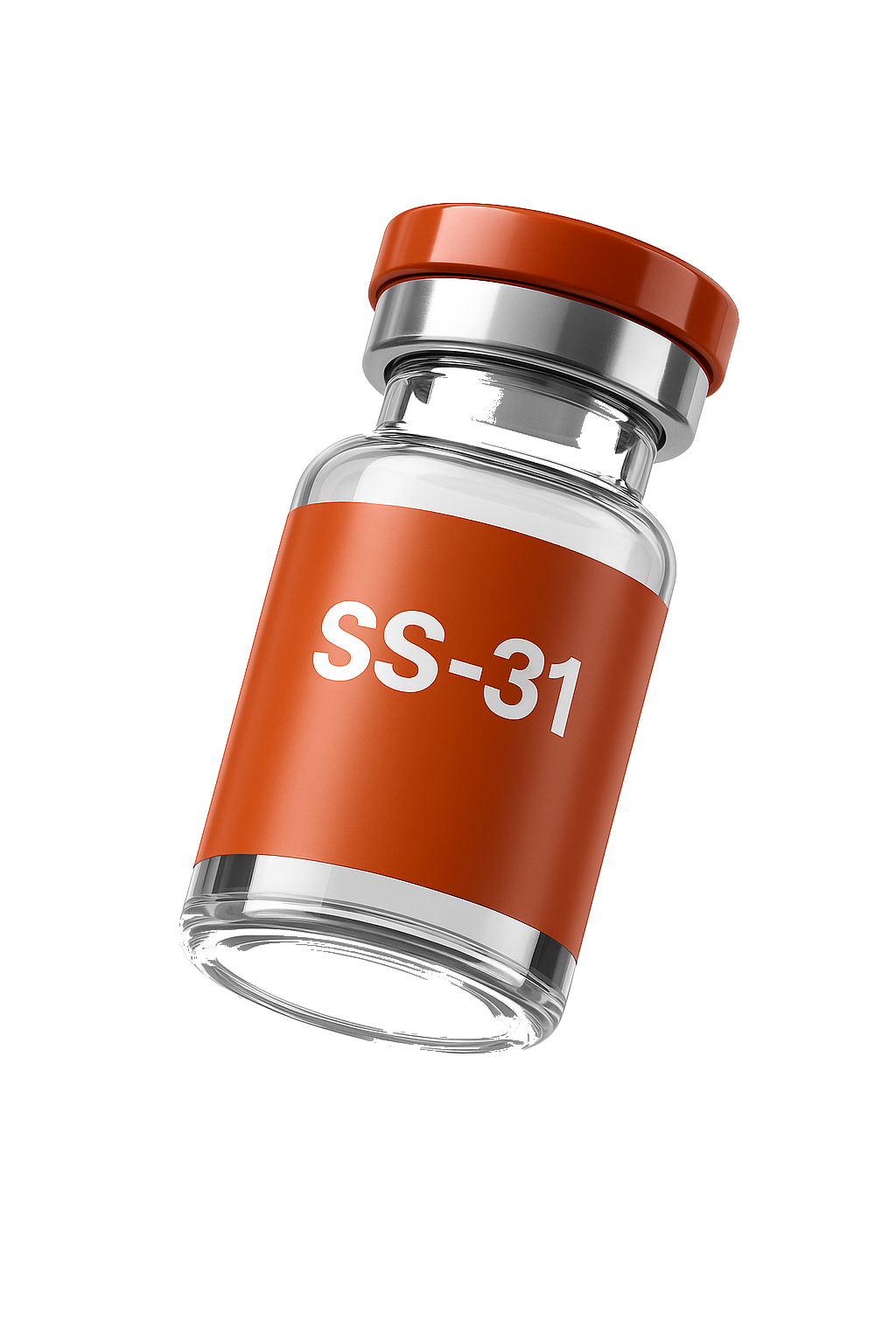
Where to buy SS-31, cheapest first.
Prices from 2 vendors across the market. We link straight to each vendor’s product page and grade vendors on public lab data, so you’re not just chasing the lowest number.
What SS-31 actually does.
The simple version first, then a little more for the curious. No biochem degree required.
It homes in on the power plants inside your cells, stabilizing the membrane they depend on so they make energy more efficiently and leak fewer damaging byproducts.
How it works
SS-31 (elamipretide) is a tetrapeptide that crosses cell membranes and concentrates in mitochondria. It binds cardiolipin, a lipid unique to the inner mitochondrial membrane, helping the membrane keep its shape so the electron transport chain runs cleanly.
Where it acts
It accumulates strongly in the inner mitochondrial membrane, the part of the cell that produces ATP. Tissues with heavy energy demand, like heart, muscle, and nerve, are where it has been studied most.
What people notice
People run it for steadier energy, less fatigue, and faster recovery from hard training. Effects are subtle and build over weeks. This is a longevity and cellular-health tool, not a stimulant.
Honest caveat: the strongest evidence is from animal models and a handful of human trials in specific mitochondrial diseases. The drug version, elamipretide, was FDA-approved in 2025 for Barth syndrome, but the research-grade SS-31 sold by vendors is a different thing, sold strictly for research use only. General anti-aging benefits in healthy people are not proven. None of this is medical advice, talk to a licensed provider before starting anything.
How to take it.
SS-31 is an injection, given subcutaneously into fat with a tiny insulin needle. It isn't an oral peptide, so the injectable form is what people run. The routine is below; for cycling and timing, see the full guide.
Reconstitute the vial
Add bacteriostatic water down the side of the vial (a 10mg vial + 2mL = 5mg/mL). Let it dissolve. Swirl gently, don't shake.
Draw your dose
On a U-100 insulin syringe, pull to your unit mark. 5mg at 5mg/mL is 100 units (1.0mL). Use the calculator if you're unsure.
Pinch and inject
Swab with alcohol, pinch a bit of fat, insert at 45–90°, push slowly. Subcutaneous into the belly is simplest. Most people dose in the morning.
Rotate your sites
Move to a different spot each time so no area gets sore or lumpy. Store the vial in the fridge between doses.

The easiest spots are the belly (about 2 inches either side of the navel), the love handles, the front of the thigh, and the back of the upper arms. Rotate every injection.
Don't do the math, let the calculator do it.
This is SS-31's typical setup, already worked out. Change any value and the draw updates instantly.
Typical SS-31 dose: in research and community use, roughly 5 to 10 mg once daily, run in cycles of about eight weeks on, then a break. Note the clinical drug dose for Barth syndrome is 40 mg daily, much higher than what hobbyists typically run.
How to cycle SS-31.
How long people run SS-31, when to take a break, and the honest reasoning behind it.
Run in cycles, then time off.
A cycle just means a defined run of time on the peptide, followed by a break. For SS-31 the common pattern is roughly eight weeks of daily dosing, then time off, rather than running it indefinitely.
Why not just run it forever? Mostly because the long-term human safety data outside of disease trials does not exist yet. The cautious and widely followed approach is to run a focused block, then stop and reassess.
- Hold the schedule through your cycle, once daily at roughly the same time each morning.
- Take a real break after about eight weeks before considering another cycle.
- Reassess with a provider if you are using it for a specific goal. Chasing a bigger dose is not the move; consistency is.
Want the full picture, on and off periods, the washout, stacking, and keeping your results? Read how peptide cycling works →
What's actually in the vial.
For one of these vendors we link the per-batch certificate itself, and the purity below is read straight off it. The rest link to the vendor's general lab-results page. We don't run the labs ourselves and we don't show a purity number unless it's printed on a certificate we link, so you can open the document and check it against the batch yourself.
| Vendor | Purity (per COA) | Batch / report | Certificate |
|---|---|---|---|
| Midwest Peptide | 99.95% | MP5001 | View COA ↗ |
What people pair it with.
SS-31 is often paired with other mitochondrial and longevity peptides. These are the combinations the community reaches for when cellular energy and aging are the goal.
Cellular energy
The two mitochondrial peptides people run together. SS-31 stabilizes the membrane so the power plant runs clean; MOTS-c signals through AMPK to boost metabolism. Different mechanisms, same goal of better cellular energy.
View stack →Healthy aging
A broader anti-aging layering. SS-31 supports the mitochondria, Epitalon is run for telomere and sleep support, and NAD+ feeds the energy pathways. Run as a longevity-focused block, not continuously.
View stack →Training support
Some people add SS-31 to a recovery protocol for the energy and endurance angle while BPC-157 handles soft-tissue repair. The two run on different rhythms in the same block.
View stack →In the same corner.
Other longevity and mitochondrial peptides people compare against SS-31.
Questions, answered straight.
Is SS-31 legal?
The drug version, elamipretide, was FDA-approved in 2025 for Barth syndrome under the brand Forzinity. But the research-grade SS-31 vendors sell is not an approved medicine and is offered strictly for research use only. It is not explicitly named on WADA's list, but unapproved substances can still be treated as prohibited, so competing athletes should be cautious. Rules vary by country, so check what applies where you are.
What does research use only actually mean?
It means the product is sold for laboratory and research purposes, not as a supplement or medicine for people. Research-grade SS-31 is not subject to the manufacturing oversight that the approved drug is, so purity can vary by supplier and lot. We aggregate prices and public lab data so you can see the landscape; what you do with that is between you and a licensed provider.
How do I store it?
Keep the sealed, freeze-dried vial in the fridge, and out of direct light. Once you mix it with bacteriostatic water, store it refrigerated and use it within about four weeks. Don't freeze a reconstituted vial.
How often do people dose it?
In research and community use a common pattern is roughly 5 to 10 mg once daily, run in cycles of about eight weeks, then a break. The clinical drug dose is higher at 40 mg daily. Use the calculator to turn your vial and dose into exact units.
Is SS-31 the same as the approved drug?
They are the same peptide chemically, elamipretide. But the approved drug, Forzinity, is a regulated medicine made under FDA oversight for Barth syndrome. The SS-31 vendors sell is research-grade material with no such oversight, which is why purity and dosing are far less certain.