Cagrilintide
A once-weekly amylin analog that works on the body's fullness signal. People run it for appetite control and weight loss, often alongside a GLP-1 like semaglutide in the combination known as CagriSema.
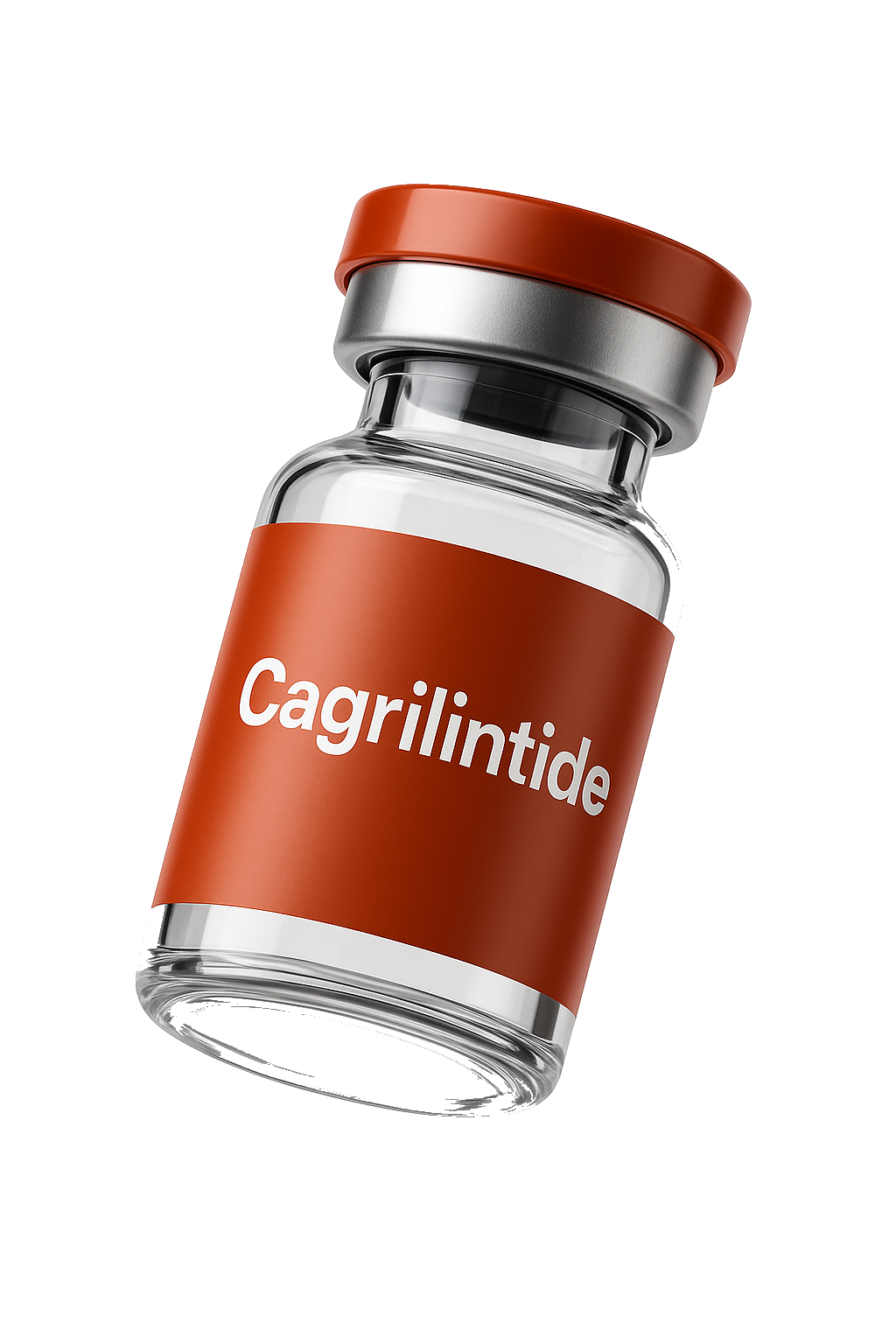
Where to buy Cagrilintide, cheapest first.
Prices from 5 vendors across the market. We link straight to each vendor’s product page and grade vendors on public lab data, so you’re not just chasing the lowest number.
Cagrilintide
What Cagrilintide actually does.
The simple version first, then a little more for the curious. No biochem degree required.
It mimics amylin, a hormone your pancreas releases with insulin after a meal, so your brain registers fullness sooner and your stomach empties more slowly. You eat less without fighting hunger as hard.
How it works
Cagrilintide is a synthetic, long-acting copy of amylin. It binds amylin and calcitonin receptors in the brainstem and hypothalamus, the regions that govern satiety, telling the body it has eaten enough.
Where it acts
It works on appetite centers in the brain and slows gastric emptying in the gut. A fatty-acid side chain keeps it circulating for about a week, so a single weekly injection holds the effect steady.
What people notice
People report a quieter appetite, smaller portions, and less food noise. Because the effect is on satiety rather than stimulation, the change tends to feel like simply wanting less food.
Honest caveat: the human data on cagrilintide is mostly from Novo Nordisk's own Phase 2 and Phase 3 obesity trials, much of it on the CagriSema combination rather than cagrilintide alone. It is not an approved medicine and is sold strictly for research use only. None of this is medical advice, talk to a licensed provider before starting anything.
How to take it.
Cagrilintide is a subcutaneous injection, given once a week into the fat with a tiny insulin needle. It isn't an oral peptide, so the injectable form is what people run. The routine is below; for the dose-escalation schedule, see the full guide.
Reconstitute the vial
Add bacteriostatic water down the side of the vial (a 10mg vial + 2mL = 5mg/mL). Let it dissolve. Swirl gently, don't shake.
Draw your dose
On a U-100 insulin syringe, pull to your unit mark. 2.4mg at 5mg/mL is 48 units (0.48mL). Start far lower while you titrate. Use the calculator if you're unsure.
Pinch and inject
Swab with alcohol, pinch a bit of fat, insert at 45–90°, push slowly. Subcutaneous into the belly is simplest. Inject the same day each week.
Rotate your sites
Move to a different spot each time so no area gets sore or lumpy. Store the vial in the fridge between doses.

The easiest spots are the belly (about 2 inches either side of the navel), the love handles, the front of the thigh, and the back of the upper arms. Rotate every injection.
Don't do the math, let the calculator do it.
This is Cagrilintide's typical setup, already worked out. Change any value and the draw updates instantly.
Typical Cagrilintide dose: a slow escalation, often starting around 0.3 mg once weekly and stepping up every few weeks toward a target near 2.4 mg once weekly. The titration is what keeps nausea manageable, so the schedule matters more than the number.
Cycling Cagrilintide.
Whether Cagrilintide is cycled at all, how long people run it, and the honest reasoning behind it.
Titrated up weekly to a maintenance dose, not cycled.
Cagrilintide is not really cycled the way a recovery peptide is. It is run continuously while you want the appetite effect, dosed once a week, with the only structure being the multi-week titration up to your target.
Why titrate so carefully? Mostly because the side effects are gastrointestinal and dose-dependent. Climbing slowly lets the gut adapt, which is the difference between a manageable run and a miserable one. There is no loading-then-maintenance pattern here, just a careful ramp to a steady weekly dose.
- Hold each titration step for about two weeks before stepping up, so the gut can adapt.
- Do not skip ahead to the target dose. Jumping straight to 2.4 mg is the fastest way to severe nausea.
- Stop the climb early if needed. If a lower step controls appetite well, there is no prize for reaching the maximum. Any concerns are a conversation for a licensed provider.
Want the full picture, on and off periods, the washout, stacking, and keeping your results? Read how peptide cycling works →
What's actually in the vial.
For 3 of these vendors we link the per-batch certificate itself (a specific lab report, COA PDF, or certificate image), and the purity below is read straight off that certificate. The rest link to the vendor's general lab-results page. We don't run the labs ourselves and we don't show a purity number unless it's printed on a certificate we link, so you can open the document and check it against the batch yourself.
| Vendor | Purity (per COA) | Batch / report | Certificate |
|---|---|---|---|
| BioLongevity Labs | 99.95% | not shown | View COA ↗ |
| Midwest Peptide | 99.752% | MPCG001 | View COA ↗ |
| Amino Club | 99.04% | CAG0001 | COA (PDF) ↗ |
What people pair it with.
Cagrilintide is most famous as half of a pairing. These are the combinations the community reaches for when appetite and weight are the goal.
Appetite & weight
The headline combination. Amylin plus GLP-1, hitting satiety from two angles. In trials it outperformed either compound alone, at the cost of more gastrointestinal side effects.
View stack →Maximal appetite control
A community variation that pairs the amylin analog with a dual GIP/GLP-1 agonist instead of semaglutide. Heavily anecdotal, with no trial backing, so titrate both slowly.
View stack →Amylin monotherapy
Run on its own for people who want the satiety effect without a GLP-1. Milder appetite suppression than the stacks, but often gentler on the gut.
View stack →In the same corner.
Other weight and metabolic peptides people compare against Cagrilintide.
Questions, answered straight.
Is Cagrilintide legal?
Cagrilintide is an investigational drug with no FDA approval. The vendors we compare offer it strictly for research use only, not for human use. As an unapproved substance it would also fall under WADA's catch-all ban on experimental drugs, so competing athletes should steer clear. Rules vary by country, so check what applies where you are.
What does research use only actually mean?
It means the product is sold for laboratory and research purposes, not as a supplement or medicine for people. It hasn't been reviewed or approved for human use by the FDA. We aggregate prices and public lab data so you can see the landscape; what you do with that is between you and a licensed provider.
How is it different from semaglutide?
Semaglutide is a GLP-1 agonist; cagrilintide is an amylin analog. They act on different satiety pathways, which is why people combine them as CagriSema. Both are once-weekly subcutaneous injections, so the routine is similar, but they are not the same class of compound.
How do I store it?
Keep the sealed, freeze-dried vial cold, ideally frozen until you mix it. Once reconstituted with bacteriostatic water, store it refrigerated and use it within about a month. Don't freeze a reconstituted vial.
How often do people dose it?
Once a week, on the same day each week, because the half-life is about a week. People escalate the dose slowly over several weeks rather than starting high. Use the calculator to turn your vial and dose into exact units.