GHK
The copper-free version of the body's own repair tripeptide, glycine-histidine-lysine. People run it for collagen, smoother skin, and hair, applied topically as a serum, where it picks up copper from the skin to become active GHK-Cu.
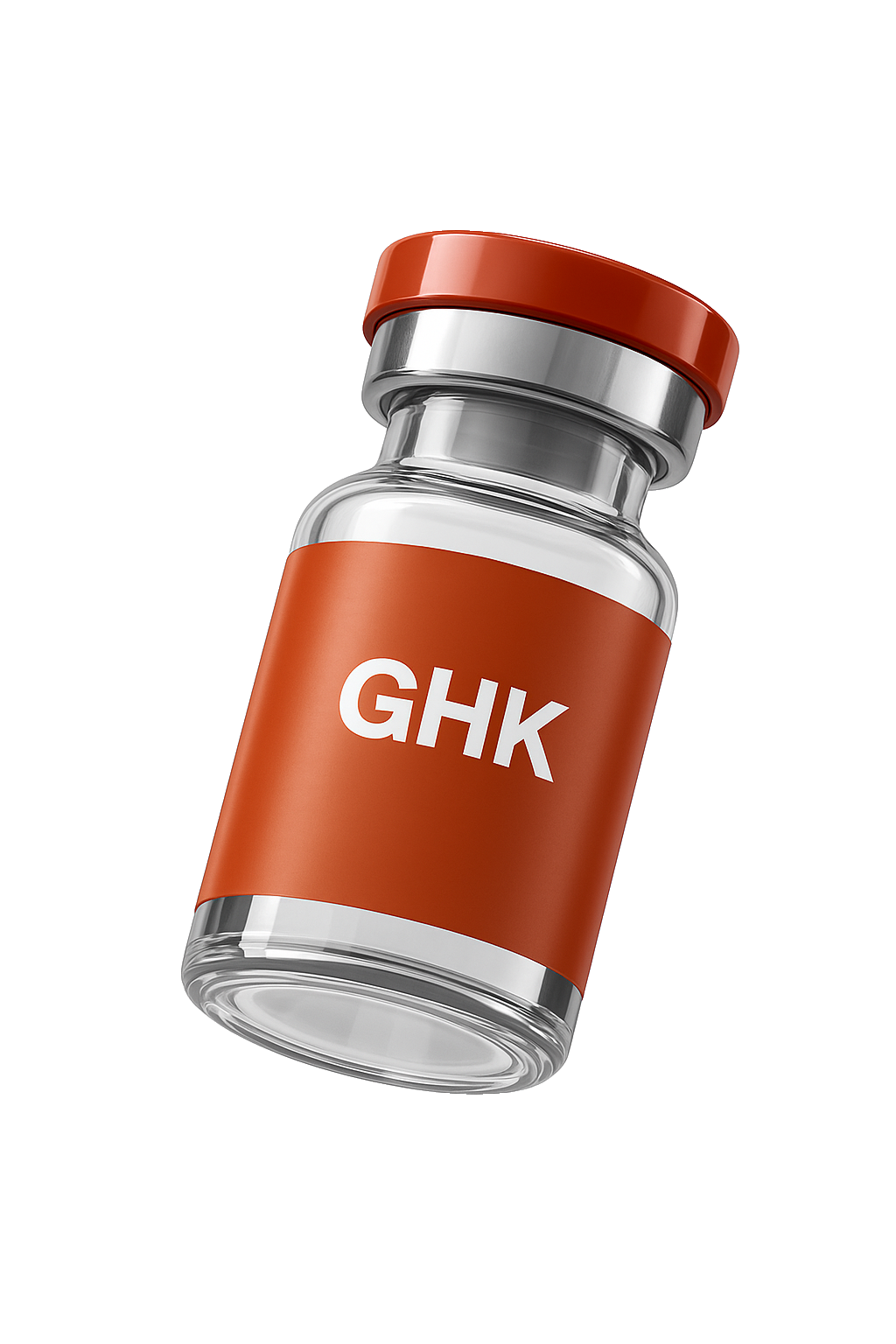
Where to buy GHK.
We track GHK across vetted vendors, but none is publicly listing a verifiable price right now. As soon as one does, it shows up here, cheapest first.
GHK
No vetted vendor is publicly listing GHK at a price we can verify yet. We don't show prices we can't stand behind, so this stays empty until one does.
Compare GHK with other peptides →What GHK actually does.
The simple version first, then a little more for the curious. No biochem degree required.
It tells skin cells to rebuild and act young again, switching on collagen and elastin production once it grabs copper in the skin, so skin looks firmer and heals better.
How it works
GHK is a tiny tripeptide (glycine-histidine-lysine) with a strong appetite for copper. On its own it is the carrier; in skin it binds free copper ions to form GHK-Cu, the active complex that signals fibroblasts to ramp up collagen, elastin, and glycosaminoglycan production.
Where it acts
Applied topically it penetrates into the upper skin layers where fibroblasts live and remodel the matrix. Its small size lets it reach cell receptors easily. On the scalp people use it to support the hair follicle. It is meant for local skin and scalp use, not systemic effects.
What people notice
People report smoother texture and better hydration within a few weeks, with firmness and tone building over a couple of months. Because GHK and GHK-Cu share the most human cosmetic data of any peptide here, expectations are a bit more grounded than most.
Honest caveat: the strongest evidence is cosmetic, on topical formulations for skin appearance, and most of it studies the copper-bound GHK-Cu form rather than bare GHK. It is not an approved medicine and is sold strictly for research use only. None of this is medical advice, talk to a licensed provider before starting anything.
How to take it.
GHK is applied topically as a serum or cream to clean skin or scalp, no needles or mixing once it is in a finished product. It is not a meaningful oral or injectable peptide for most people, so topical is the route that matters. The routine is below; for formulating, pairing, and copper, see the full guide.
Clean the area
Wash and pat dry the skin or scalp first. GHK absorbs best into clean skin, with no leftover oils, makeup, or other actives sitting on top.
Apply the serum
Smooth a thin layer of GHK serum or cream over the area. A typical cosmetic strength is around 1 to 2 percent. A few drops or a pea-sized amount is plenty; use the same amount each time.
Let it absorb
Give it a few minutes to sink in before layering anything else. Avoid pairing it directly with strong acids or high-dose vitamin C in the same step, which can disrupt the copper it relies on.
Stay consistent
Use it once or twice daily. Effects build over weeks, not days. Store the serum cool and out of direct light, and keep any reconstituted vial in the fridge.
Typical GHK dose: a topical serum or cream at roughly 1 to 2 percent, applied once or twice daily to clean skin or scalp. Effects build over weeks, and most people run it continuously like any skincare active rather than in strict cycles.
Cycling GHK.
Whether GHK is cycled at all, how long people run it, and the honest reasoning behind it.
Used ongoing like a skincare active, not strictly cycled.
Unlike injectable peptides that run in defined loading and maintenance cycles, topical GHK is usually treated like any other skincare active: you use it continuously, day in and day out, and judge it over months.
Why no strict cycle? Because it is acting locally on skin renewal, which is a slow, ongoing process. There is no loading phase to build up and no clear reason to pulse it on and off. If your skin gets irritated, you simply scale back frequency.
- Use it consistently, once or twice a day, rather than in bursts. Skin remodeling is gradual.
- Scale back, do not push through irritation. If you get redness or stinging, drop to once a day or every other day.
- Give it months, not days. Texture and hydration can shift in a few weeks, but firmness and tone take longer.
Want the full picture, on and off periods, the washout, stacking, and keeping your results? Read how peptide cycling works →
What's actually in the vial.
We haven't yet found a vendor publishing a lab certificate for GHK that we can link to directly. We don't post purity numbers we can't source. When a vendor publishes a real GHK COA, it'll show up here.
What people pair it with.
GHK is the copper-peptide piece people add when skin and appearance are part of the goal, not just internal repair.
Topical pairing
A topical copper-peptide duo. GHK leads on collagen and skin firmness; AHK-Cu is added by people focused on the hair-follicle and scalp side. Both are applied to clean skin or scalp.
View stack →Skin & soothing
A calmer-skin pairing. GHK drives collagen and remodeling while topical KPV is run by people who want to dial down redness and irritation alongside it.
View stack →Skin & recovery
The injectable repair stack people run for skin as well as tissue. It uses the copper-bound GHK-Cu form rather than bare GHK, layered on a BPC-157 and TB-500 healing base.
View stack →In the same corner.
Other healing and skin peptides people compare against GHK.
Questions, answered straight.
Is GHK legal?
GHK and its copper form are widely sold and used in cosmetic, topical skincare, where GHK-Cu is a common ingredient. Sold as a raw research peptide it is not an approved medicine, and the vendors we compare offer it strictly for research use only. It is not specifically named on WADA's prohibited list, but related language can still apply, so competing athletes should be cautious. Rules vary by country, so check what applies where you are.
What is the difference between GHK and GHK-Cu?
GHK is the bare tripeptide; GHK-Cu is the same peptide already bound to a copper ion. The copper is what powers most of the repair enzymes, so GHK-Cu is the active, ready-to-use form. Applied to skin, bare GHK grabs free copper and effectively becomes GHK-Cu, which is why the two are often discussed together and why much of the human evidence is on the copper-bound form.
What does research use only actually mean?
It means the raw product is sold for laboratory and research purposes, not as a supplement or medicine for people. It has not been reviewed or approved for human use by the FDA. We aggregate prices and public lab data so you can see the landscape; what you do with that is between you and a licensed provider.
How do I store it?
Keep a finished topical serum cool and out of direct light, and follow its label. Raw GHK powder keeps best frozen and sealed; once mixed into a water-based vehicle, refrigerate it and use it within a few weeks. Low-pH or strongly acidic vehicles can destabilize the copper, so they are usually avoided.
Can I use it with vitamin C or acids?
Best not in the same step. Strong acids and high-dose vitamin C can disrupt the copper that makes GHK work, so many people use it at a separate time of day, for example acids in the morning and GHK at night.