Melanotan I
A synthetic copy of alpha-melanocyte-stimulating hormone (alpha-MSH). People run it for a UV-driven tan with less sun, and because it is more selective for the pigment receptor than Melanotan II, they reach for it when they want the tan with fewer of the systemic and sexual side effects.
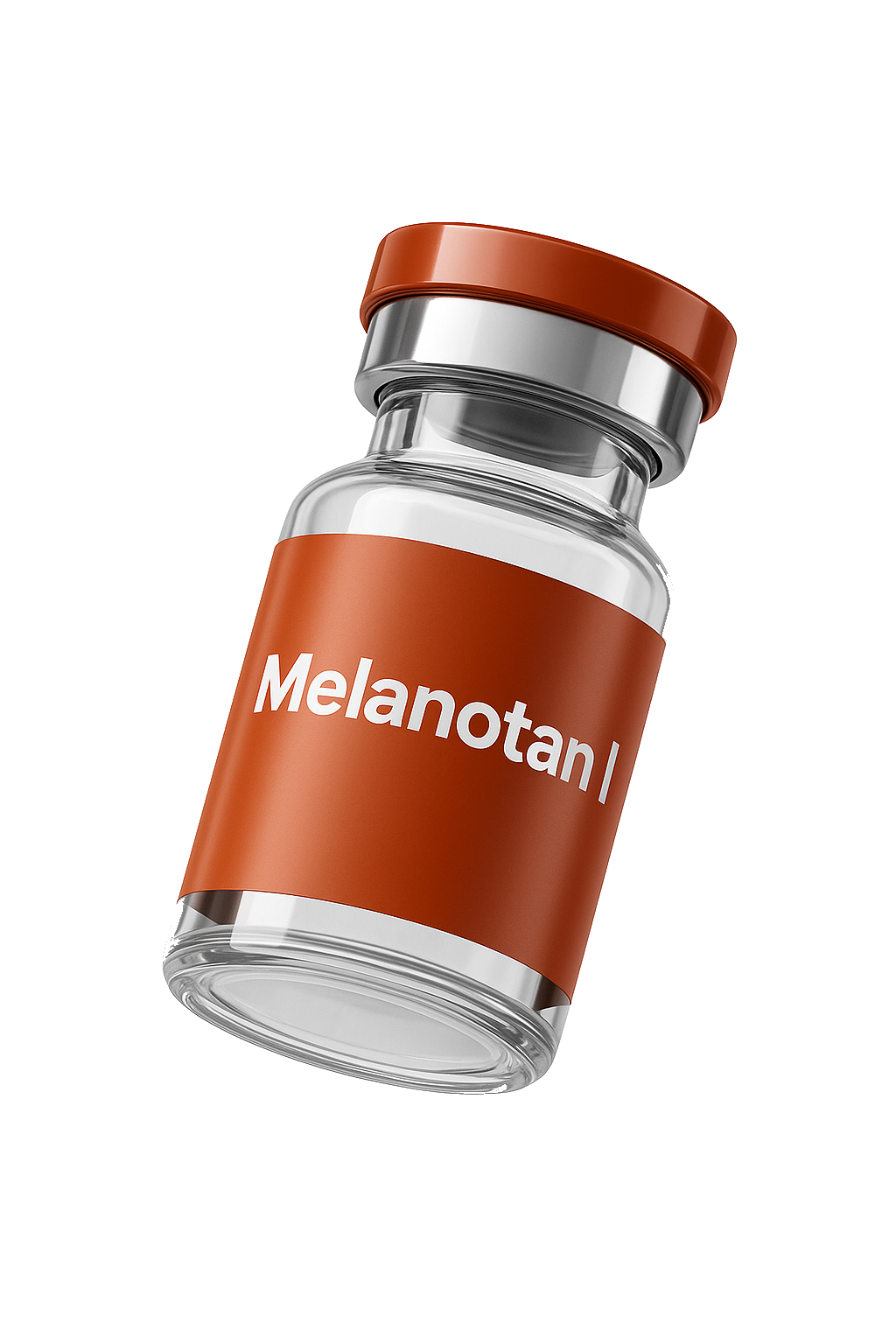
Where to buy Melanotan I, cheapest first.
Prices from 4 vendors across the market. We link straight to each vendor’s product page and grade vendors on public lab data, so you’re not just chasing the lowest number.
Melanotan I
What Melanotan I actually does.
The simple version first, then a little more for the curious. No biochem degree required.
It mimics the hormone that tells your skin to make pigment, switching on melanocytes so you tan faster and darker with less UV exposure than you would on your own.
How it works
Melanotan I is a synthetic analog of alpha-MSH, the natural hormone that signals pigment cells. It binds the melanocortin-1 receptor (MC1R) on melanocytes and switches on eumelanin production, the darker, more protective form of melanin.
Where it acts
It works mainly at the skin's pigment cells. Compared with Melanotan II, it is more selective for MC1R and touches the MC3R and MC4R pathways less, which is why people associate it with a cleaner tan and fewer of the appetite, nausea, and libido effects.
What people notice
With ongoing UV exposure, people report skin darkening over a couple of weeks, more even color, and fewer burns. The plasma half-life is short, but the tanning effect outlasts it because melanocytes keep depositing pigment after the signal.
Honest caveat: the closest thing to real human evidence here is afamelanotide (Scenesse), a related MC1R agonist approved only for a rare light-sensitivity disorder, not for cosmetic tanning. The injectable Melanotan I sold by vendors has not been studied as a tanning agent in healthy people, and it is sold strictly for research use only. None of this is medical advice, talk to a licensed provider before starting anything.
How to take it.
Melanotan I is an injection, given subcutaneously into a pinch of fat with a tiny insulin needle. It isn't an oral or nasal peptide, so the injectable form is what people run. It is dosed in micrograms, not milligrams, so the units are small. The routine is below; for cycling and timing, see the full guide.
Reconstitute the vial
Add bacteriostatic water down the side of the vial (a 10mg vial + 2mL = 5mg/mL). Let it dissolve. Swirl gently, don't shake.
Draw your dose
On a U-100 insulin syringe, pull to your unit mark. 250mcg at 5mg/mL is 5 units (0.05mL). Use the calculator if you're unsure, the units are small.
Pinch and inject
Swab with alcohol, pinch a bit of fat, insert at 45–90°, push slowly. Subcutaneous into the belly is simplest. Some people dose in the evening so any flush or nausea passes while they rest.
Rotate your sites
Move to a different spot each time so no area gets sore or lumpy. Store the vial in the fridge between doses.

The easiest spots are the belly (about 2 inches either side of the navel), the love handles, the front of the thigh, and the back of the upper arms. Rotate every injection.
Don't do the math, let the calculator do it.
This is Melanotan I's typical setup, already worked out. Change any value and the draw updates instantly.
Typical Melanotan I dose: about 250 mcg twice a week during a loading phase of roughly four weeks alongside regular UV exposure, then 250 mcg once or twice a week to maintain the color. It's run in cycles, not continuously.
How to cycle Melanotan I.
How long people run Melanotan I, when to take a break, and the honest reasoning behind it.
Loading with UV exposure, then weekly maintenance.
A cycle just means a defined run of time on the peptide, followed by a break. For Melanotan I the common pattern is a loading phase of roughly four weeks with UV exposure, then a lighter weekly maintenance dose while you want to keep the color, then time off, rather than running it indefinitely.
Why not just run it forever? Mostly because the long-term human safety data does not exist for cosmetic use, and ongoing melanocortin stimulation is not something anyone has studied for years on end in healthy people. The cautious approach is to run a focused block, then stop.
- Start low with a small test dose to see how you react before holding a regular schedule.
- Pair it with sensible UV, not extreme sun. The point of a protective tan is undermined if you burn chasing it faster.
- Take a real break after a cycle and let the tan fade. Watch your skin: new or changing moles are a reason to stop and see a provider.
Want the full picture, on and off periods, the washout, stacking, and keeping your results? Read how peptide cycling works →
What's actually in the vial.
For 3 of these vendors we link the per-batch certificate itself (a specific lab report, COA PDF, or certificate image), and the purity below is read straight off that certificate. The rest link to the vendor's general lab-results page. We don't run the labs ourselves and we don't show a purity number unless it's printed on a certificate we link, so you can open the document and check it against the batch yourself.
| Vendor | Purity (per COA) | Batch / report | Certificate |
|---|---|---|---|
| EZ Peptides | 99.845% | EZP-MEL11005072026-04 | Janoshik report ↗ |
| Midwest Peptide | 99.68% | MPMT1002 | View COA ↗ |
| Amino Club | 99.68% | MI0001 | COA (PDF) ↗ |
What people pair it with.
Melanotan I is usually run on its own for tanning, but a few combinations come up depending on the goal. These are the ones people actually reach for.
Pigment, cleaner profile
Melanotan I run solo with UV exposure. People pick MT-I over MT-II specifically when they want the tan without the stronger nausea, flushing, and libido effects that come with the less selective peptide.
View stack →Tan plus on-demand desire
MT-I handles the pigment while PT-141 (bremelanotide), a focused MC4R agonist, is dosed separately and only when wanted for arousal. Keeping them separate avoids stacking the side effects of a single broad-acting peptide.
View stack →The darker, broader option
Not a stack so much as the alternative. Melanotan II tans faster at lower doses and adds a libido effect, but hits more receptors and brings more side effects. People cross-shop the two before committing.
View stack →In the same corner.
Other melanocortin and sexual-health peptides people compare against Melanotan I.
Questions, answered straight.
Is Melanotan I legal?
Melanotan I isn't an approved tanning drug, and it isn't sold for human use. The vendors we compare offer it strictly for research use only. A related compound, afamelanotide, is approved only for a rare light-sensitivity disorder, not cosmetic tanning. Melanocortin receptor agonists are also banned in sport by WADA, so competing athletes should steer clear. Rules vary by country, so check what applies where you are.
What does research use only actually mean?
It means the product is sold for laboratory and research purposes, not as a supplement or medicine for people. It hasn't been reviewed or approved for human use by the FDA as a tanning agent. We aggregate prices and public lab data so you can see the landscape; what you do with that is between you and a licensed provider.
How is it different from Melanotan II?
Melanotan I is more selective for the pigment receptor (MC1R), so people associate it with a cleaner tan and fewer of the nausea, flushing, appetite, and libido effects. Melanotan II hits more receptors, so it tans faster at lower doses but brings more side effects. You generally need a bit more MT-I than MT-II for the same color.
How do I store it?
Keep the sealed, freeze-dried vial in the fridge, and out of direct light. Once you mix it with bacteriostatic water, store it refrigerated and use it within about four weeks. Don't freeze a reconstituted vial.
Do I still need sun or UV?
Yes. Melanotan I primes your skin to make pigment, but it works with UV exposure, not instead of it. People still report a tan needs some sun or a tanning bed to develop, and going overboard on UV to speed it up defeats the point of a protective tan. New or changing moles are a reason to stop and see a provider.