PE-22-28
A synthetic heptapeptide derived from spadin that blocks the TREK-1 potassium channel in the brain. People run it as a nasal spray for mood, low-grade depression, and as a research tool for neurogenesis, often alongside Semax or Selank.
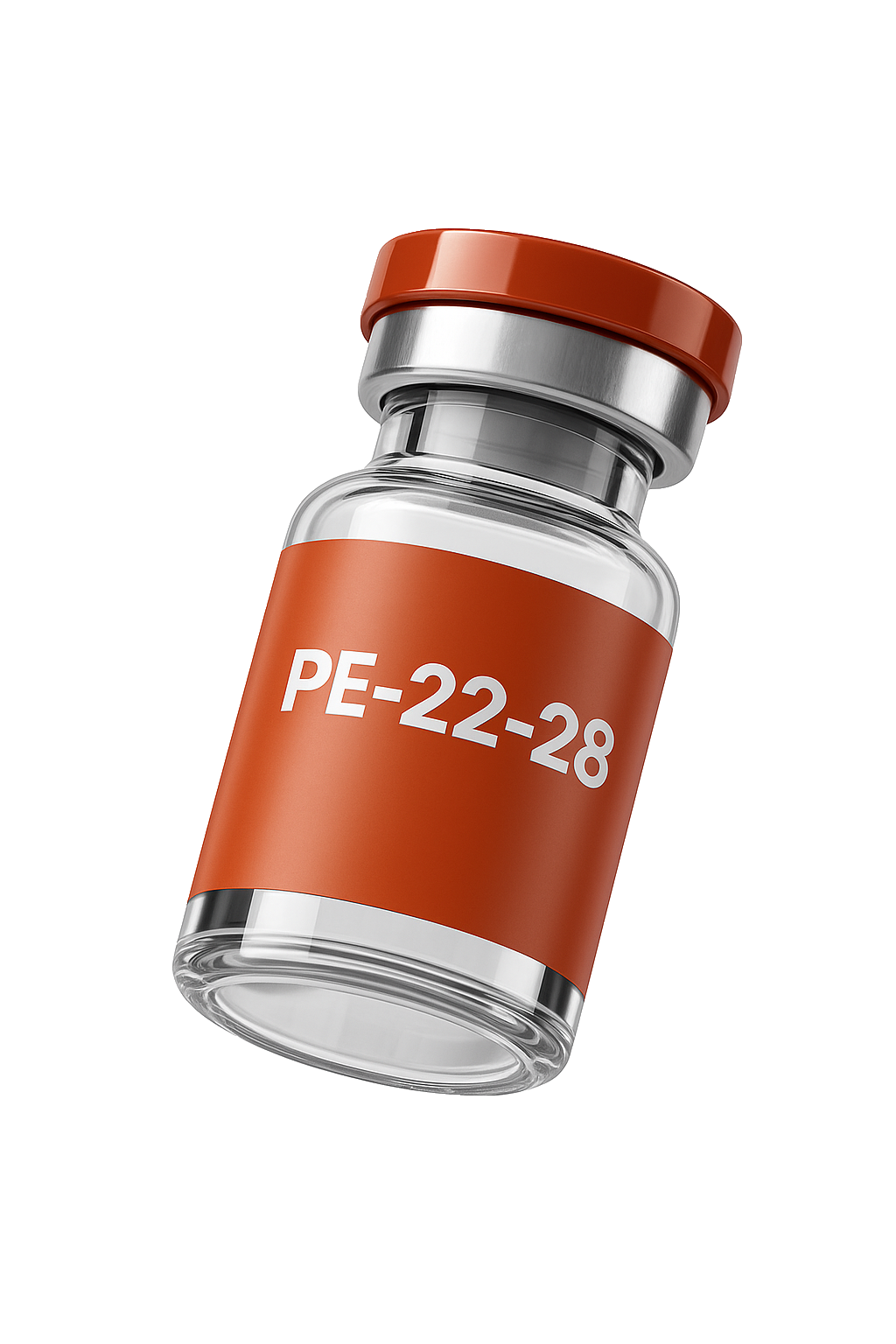
Where to buy PE-22-28, cheapest first.
Prices from 2 vendors across the market. We link straight to each vendor’s product page and grade vendors on public lab data, so you’re not just chasing the lowest number.
What PE-22-28 actually does.
The simple version first, then a little more for the curious. No biochem degree required.
It blocks a brain potassium channel called TREK-1, which makes serotonin-releasing neurons a little more active. In animal studies that translated into an antidepressant-like effect and new neuron growth.
How it works
PE-22-28 is a shortened, more potent analog of spadin, a natural fragment of the sortilin propeptide. It selectively inhibits TREK-1, a two-pore potassium channel. Blocking TREK-1 nudges serotonergic neurons toward firing, which is the same target validated by depression-resistant TREK-1 knockout mice.
Where it acts
TREK-1 sits in mood-related brain regions like the hippocampus and prefrontal cortex. The intranasal route is favored because it can reach the central nervous system through the olfactory and trigeminal nerve pathways, bypassing some of the bloodstream barriers.
What people notice
In animal models PE-22-28 produced antidepressant-like effects within days and boosted hippocampal neurogenesis over weeks. Human reports are anecdotal and describe a steadier mood floor. Effects, where reported, are described as gradual, not a stimulant hit.
Honest caveat: essentially all of this comes from rodent and lab studies. The original spadin and PE-22-28 work was done in mice, and there are no completed human clinical trials, no validated human dose, and no human safety data. It is not an approved medicine and is sold strictly for research use only. None of this is medical advice, talk to a licensed provider before starting anything.
How to take it.
PE-22-28 is most commonly used as a nasal spray, which puts it close to the brain through the nasal nerves. Some researchers also run it as a subcutaneous injection. The nasal routine is below; lead with it, and note the subcutaneous option if you prefer to inject.
Reconstitute into a spray bottle
Add bacteriostatic water to the freeze-dried vial down the side, swirl gently, then transfer to a clean nasal-spray bottle. Work out how many micrograms each spray delivers based on your total mg and water volume.
Prime the pump
With a fresh bottle, pump a few times into a tissue until a fine mist comes out, so your first real spray is a full, accurate dose.
Spray per nostril
Tip your head slightly forward, close one nostril, and deliver your measured sprays. A common target is roughly 100–300 mcg total per day, split between nostrils. Sniff gently, do not snort hard.
Alternate nostrils & store cold
Switch which nostril you start with each dose to reduce irritation. Keep the bottle refrigerated between uses and out of direct light.
Typical PE-22-28 dose: about 100–300 mcg per day intranasally (or 100–300 mcg subcutaneously), usually once daily in the morning, cycled roughly 4 to 8 weeks on with a 2 to 4 week break. These are scaled-from-animal community numbers, not established therapeutic doses.
How to cycle PE-22-28.
How long people run PE-22-28, when to take a break, and the honest reasoning behind it.
Cycled in short blocks, not continuously.
A cycle just means a defined run of time on the peptide, followed by a break. For PE-22-28 the common pattern is roughly 4 to 8 weeks on, then a 2 to 4 week break, rather than running it indefinitely.
Why not just run it forever? Mostly because the long-term human safety data does not exist at all. The cautious and widely followed approach is to run a focused block, then stop and reassess.
- Hold the schedule through your on-weeks, once a day at roughly the same time.
- Take a real break of a few weeks between cycles rather than running it back to back.
- Reassess after each cycle. If you are using it for a mood issue, that is a conversation for a licensed provider, not a forum.
Want the full picture, on and off periods, the washout, stacking, and keeping your results? Read how peptide cycling works →
What's actually in the vial.
We haven't yet found a vendor publishing a lab certificate for PE-22-28 that we can link to directly. We don't post purity numbers we can't source. When a vendor publishes a real PE-22-28 COA, it'll show up here.
What people pair it with.
PE-22-28 is a mood-and-cognition peptide, so people pair it with other nasal nootropics rather than the healing stacks. These are the combinations the community reaches for.
Mood & calm
Selank takes the edge off anxious overthinking while PE-22-28 is run to lift the serotonergic mood floor. A frequently recommended nasal pairing for people whose main goal is steadier mood.
View stack →Focus & mood
Semax is run for drive and focus through dopaminergic and neurotrophic pathways, while PE-22-28 is run for the mood side. The two are seen as complementary rather than competing nasal nootropics.
View stack →Neuro support
A more experimental research pairing. Dihexa is studied for synapse formation while PE-22-28 targets TREK-1 and neurogenesis. Both are early-evidence compounds, so this is firmly a research-only combination.
View stack →In the same corner.
Other cognitive and mood peptides people compare against PE-22-28.
Questions, answered straight.
Is PE-22-28 legal?
PE-22-28 is not an approved drug and is not sold for human use. The vendors we compare offer it strictly for research use only. It falls under WADA's S0 category (non-approved substances), so competing athletes should steer clear. Rules vary by country, so check what applies where you are.
What does research use only actually mean?
It means the product is sold for laboratory and research purposes, not as a supplement or medicine for people. It has not been reviewed or approved for human use by the FDA, and there are no completed human trials. We aggregate prices and public lab data so you can see the landscape; what you do with that is between you and a licensed provider.
How do I store it?
Keep the sealed, freeze-dried vial in the fridge and out of direct light. Once you mix it with bacteriostatic water and transfer it to a spray bottle, keep it refrigerated and use it within a few weeks. Do not freeze a reconstituted bottle.
Nasal spray or injection?
Both routes are used. Intranasal is the most common because it can reach the brain through the nasal nerves and needs no needle; some researchers prefer subcutaneous injection for more consistent dosing. The compound is the same either way.
How long until anything happens?
In animal studies antidepressant-like effects appeared within a few days, while the neurogenesis effects built over weeks. Human reports are anecdotal and describe gradual changes, not an immediate hit. Treat any timeline as unproven in people.