Tesamorelin
A synthetic analog of growth hormone-releasing hormone, and one of the few peptides here with a real FDA approval (as Egrifta, for HIV-related belly fat). People run it to cut visceral fat and to nudge their own growth hormone up, without injecting GH directly.
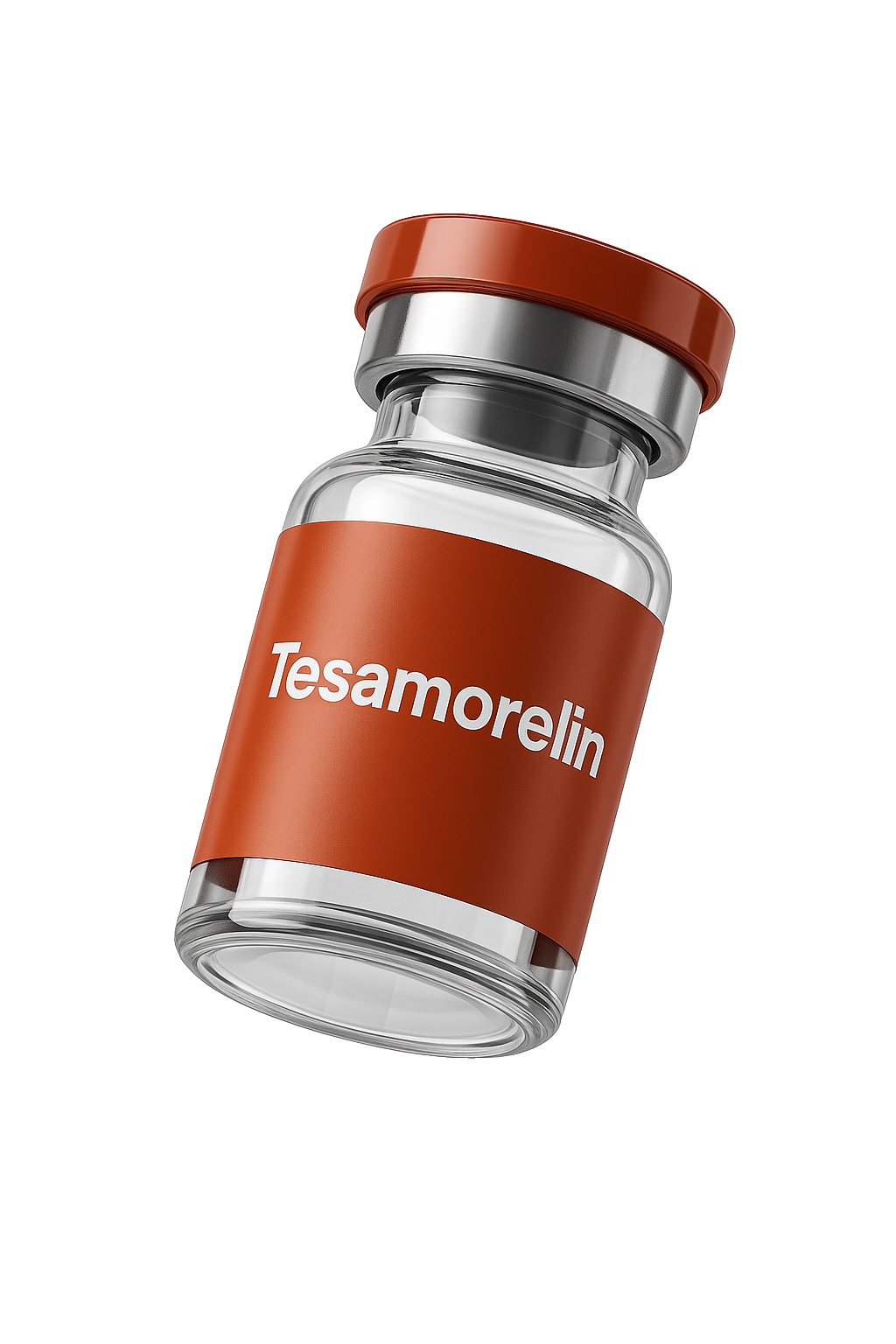
Where to buy Tesamorelin, cheapest first.
Prices from 10 vendors across the market. We link straight to each vendor’s product page and grade vendors on public lab data, so you’re not just chasing the lowest number.
Tesamorelin
What Tesamorelin actually does.
The simple version first, then a little more for the curious. No biochem degree required.
It tells your pituitary to release more of your own growth hormone, in the natural pulsing rhythm, which over weeks shifts the body toward burning deep abdominal fat.
How it works
Tesamorelin is a stabilized version of GHRH, the signal your brain normally uses to ask the pituitary for growth hormone. It binds the GHRH receptor and prompts your own GH release in pulses, rather than flooding the body with synthetic GH.
Where it acts
The action starts in the pituitary, but the downstream effect people care about is on fat. The extra GH (and the IGF-1 it raises) drives lipolysis, with the clearest, best-documented effect on visceral adipose tissue, the deep fat around the organs.
What people notice
The studied, headline effect is a meaningful drop in visceral belly fat over months, often with better waist measurements and lipid panels. It builds slowly over weeks, not days, and is not a dramatic muscle-builder on its own.
Honest caveat: tesamorelin is genuinely FDA-approved for one narrow use, reducing excess abdominal fat in HIV-associated lipodystrophy, and that is where the strong human evidence sits. Everything else people run it for, general fat loss, anti-aging, body recomposition, is off-label and far less studied. The vendors we compare sell it strictly for research use only. None of this is medical advice, talk to a licensed provider before starting anything.
How to take it.
Tesamorelin is an injection, given subcutaneously into the fat of the belly with a tiny insulin needle, usually once a day in the evening. It isn't an oral peptide, so the injectable form is what people run. The routine is below; for cycling and timing, see the full guide.
Reconstitute the vial
Add bacteriostatic water down the side of the vial (a 10mg vial + 2mL = 5mg/mL). Let it dissolve. Swirl gently, don't shake.
Draw your dose
On a U-100 insulin syringe, pull to your unit mark. 2mg at 5mg/mL is 40 units (0.4mL). Use the calculator if you're unsure.
Pinch and inject
Swab with alcohol, pinch a bit of belly fat, insert at 45–90°, push slowly. The abdomen is the standard site; inject at roughly the same time each evening.
Rotate your sites
Move to a different spot on the belly each time so no area gets sore or develops fat loss (lipoatrophy). Store the vial in the fridge between doses.

The standard spot is the belly (about 2 inches either side of the navel), and people also use the love handles, the front of the thigh, and the back of the upper arms. Rotate every injection.
Don't do the math, let the calculator do it.
This is Tesamorelin's typical setup, already worked out. Change any value and the draw updates instantly.
Typical Tesamorelin dose: 2 mg subcutaneously once a day, the FDA-approved dose, usually in the evening. Many people run a 5-days-on, 2-days-off pattern and cycle in blocks of a few months rather than continuously.
How to cycle Tesamorelin.
How long people run Tesamorelin, when to take a break, and the honest reasoning behind it.
A 5-days-on, 2-days-off pattern, cycled in blocks.
A cycle just means a defined run of time on the peptide, followed by a break. For tesamorelin the common pattern is daily dosing, often 5 days on and 2 days off, run in blocks of a few months, then time off, rather than indefinitely.
Why not just run it forever? Two reasons. Practically, the receptors can desensitize, so a break helps keep it working. And on safety, tesamorelin raises IGF-1, and the long-term effects of keeping IGF-1 elevated for years are not something the off-label data can answer.
- Hold the daily rhythm through your on-days, injecting at roughly the same time each evening.
- Build in the off-days, commonly 2 a week, to give the GHRH receptors a regular rest.
- Take a real break after a few-month block before considering another. If you are monitoring labs, IGF-1 and glucose are the two to watch with a provider.
Want the full picture, on and off periods, the washout, stacking, and keeping your results? Read how peptide cycling works →
What's actually in the vial.
For 7 of these vendors we link the per-batch certificate itself (a specific lab report, COA PDF, or certificate image), and the purity below is read straight off that certificate. The rest link to the vendor's general lab-results page. We don't run the labs ourselves and we don't show a purity number unless it's printed on a certificate we link, so you can open the document and check it against the batch yourself.
| Vendor | Purity (per COA) | Batch / report | Certificate |
|---|---|---|---|
| EZ Peptides | 99.857% | EZP-TES1003212026-20 | Janoshik report ↗ |
| BioLongevity Labs | 99.97% | 10166 | View COA ↗ |
| Spartan Peptides | 99.97% | PEP-04-26 | View COA ↗ |
| Onyx Biolabs | 99.852% | TES10-260312A | View COA ↗ |
| Midwest Peptide | 99.5% | MPTA004 | View COA ↗ |
| Swiss Chems | 99.2% | ED6847 | View COA ↗ |
| Next Gen Peptides | see lab page | not shown | Lab results ↗ |
| Penguin Peptides | see lab page | not shown | Lab results ↗ |
| Amino Club | 99.61% | TES0002 | COA (PDF) ↗ |
What people pair it with.
Tesamorelin is a growth hormone peptide, so it stacks with the other GH-axis compounds rather than the healing blends. These are the combinations people reach for when fat loss and GH support are the goal.
GH from two angles
Tesamorelin pushes GHRH while Ipamorelin works on the ghrelin side as a clean GH secretagogue. The two pathways are run together to get a fuller, more natural GH pulse, with tesamorelin carrying the visceral-fat angle.
View stack →Sustained GHRH drive
Both act on the GHRH pathway, so people pair them for a steadier signal, often with Ipamorelin added as the third leg. Dosed once daily, usually together in the evening on an empty stomach.
View stack →Fat loss & recovery
A practical off-season pairing: tesamorelin handles the GH and visceral-fat side while BPC-157 is run for soft-tissue recovery. The two are on different rhythms but fit in the same block.
View stack →In the same corner.
Other growth hormone peptides people compare against Tesamorelin.
Questions, answered straight.
Is Tesamorelin legal?
Tesamorelin is actually FDA-approved as a prescription drug (Egrifta) for HIV-related abdominal fat, so it is a real medicine in that narrow setting. The research vials the vendors we compare sell are a different thing, offered strictly for research use only, not as a supplement or prescription. It is also on WADA's prohibited list as a growth hormone-releasing factor, so competing athletes should steer clear. Rules vary by country, so check what applies where you are.
What does research use only actually mean?
It means the vendor product is sold for laboratory and research purposes, not as a supplement or a substitute for the approved prescription drug. We aggregate prices and public lab data so you can see the landscape; what you do with that is between you and a licensed provider.
How do I store it?
Keep the sealed, freeze-dried vial in the fridge and out of direct light. Once you mix it with bacteriostatic water, store it refrigerated and use it within about a week, since the approved label is conservative about reconstituted shelf life. Don't freeze a reconstituted vial.
How often do people dose it?
The approved dose is 2 mg once daily, typically in the evening. Off-label, many people run a 5-days-on, 2-days-off pattern and cycle in blocks of a few months to limit receptor desensitization. Use the calculator to turn your vial and dose into exact units.
Will it raise my blood sugar?
It can. Because tesamorelin works by raising your own growth hormone and IGF-1, it can worsen glucose tolerance and is a real concern for anyone with diabetes or pre-diabetes. The approved label calls for checking glucose before starting and monitoring during use. This is a conversation for a licensed provider, not a forum.