Pinealon
A synthetic three-amino-acid peptide (Glu-Asp-Arg) from the Khavinson bioregulator family. People run it for brain support and healthy aging, studied for neuroprotection, cognition, and oxidative stress, often alongside Epitalon in short cycles.
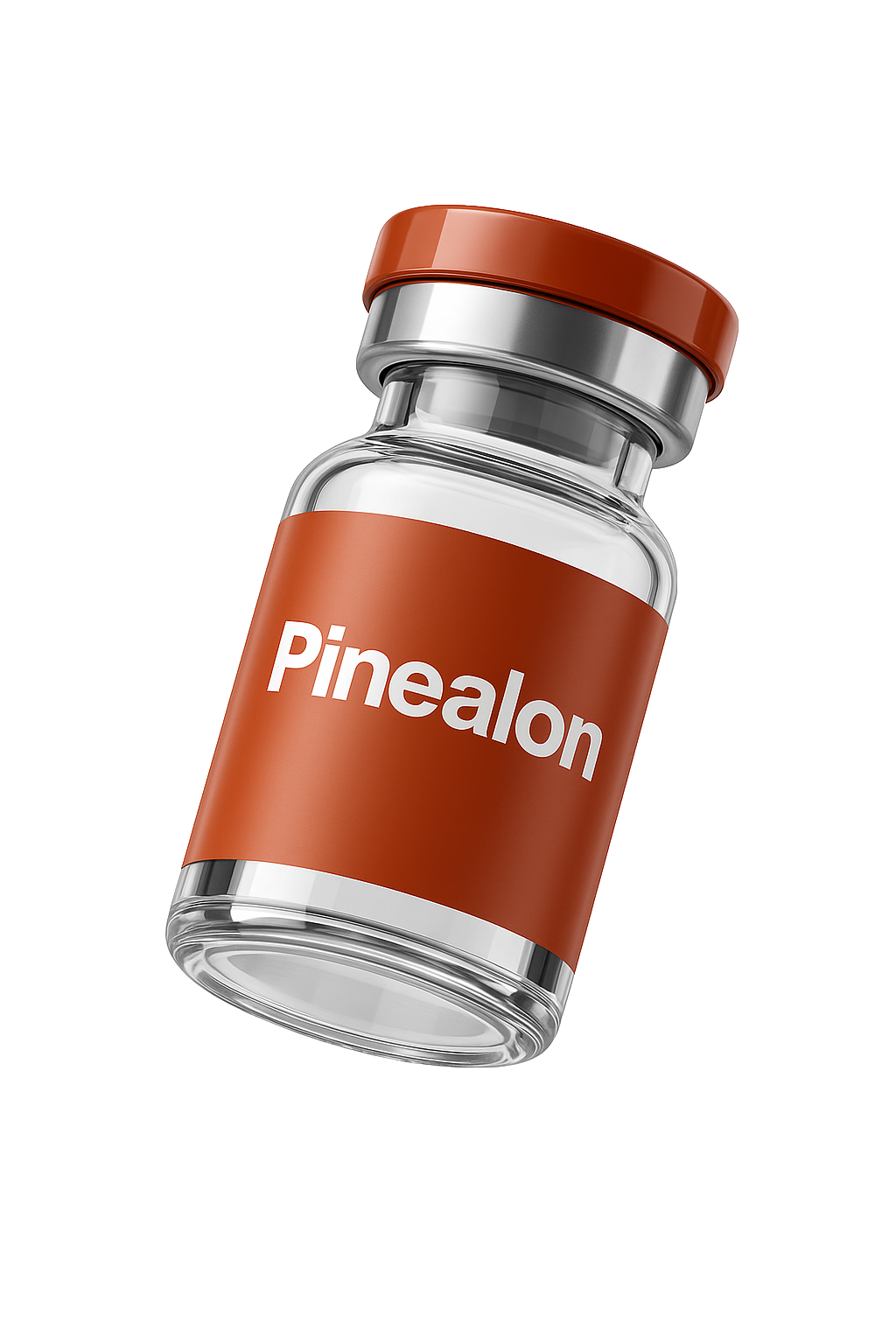
Where to buy Pinealon, cheapest first.
Prices from 3 vendors across the market. We link straight to each vendor’s product page and grade vendors on public lab data, so you’re not just chasing the lowest number.
What Pinealon actually does.
The simple version first, then a little more for the curious. No biochem degree required.
It is a tiny peptide that is studied for slipping into brain cells and helping switch on the body's own repair and protection programs, calming oxidative stress so neurons hold up better under strain.
How it works
Pinealon is the tripeptide Glu-Asp-Arg, also called EDR. Khavinson's bioregulator theory proposes that short, charged peptides like this enter cells, reach the nucleus, and interact with regulatory DNA, nudging gene expression toward repair and protection rather than acting like a hormone.
Where it acts
It is studied mostly in neural tissue, the brain cortex in particular. In lab models it crosses the blood-brain barrier and is associated with reduced reactive oxygen species and better-preserved mitochondrial function in stressed neurons.
What people notice
People run it on short cycles hoping for sharper focus, steadier mood, and better sleep. Reported effects are subtle and build over a course rather than arriving as a single dose, and they vary a lot from person to person.
Honest caveat: almost all of this comes from cell-culture and rodent studies, much of it from the Khavinson group in Russia, and human trials are small and limited. The epigenetic mechanism is a hypothesis, not settled fact. It is not an approved medicine and is sold strictly for research use only. None of this is medical advice, talk to a licensed provider before starting anything.
How to take it.
Pinealon is an injection, given subcutaneously into fat with a tiny insulin needle. Some people use an oral capsule form, but the bioregulator protocols that the research describes are injectable, so that is what people run. The routine is below; for cycling and timing, see the full guide.
Reconstitute the vial
Add bacteriostatic water down the side of the vial (a 20mg vial + 2mL = 10mg/mL). Let it dissolve. Swirl gently, don't shake.
Draw your dose
On a U-100 insulin syringe, pull to your unit mark. 10mg at 10mg/mL is 100 units (1mL). Use the calculator if you're unsure.
Pinch and inject
Swab with alcohol, pinch a bit of fat, insert at 45–90°, push slowly. Subcutaneous into the belly is simplest. Most people dose once daily across a short cycle.
Rotate your sites
Move to a different spot each time so no area gets sore or lumpy. Store the vial in the fridge between doses.

The easiest spots are the belly (about 2 inches either side of the navel), the love handles, the front of the thigh, and the back of the upper arms. Rotate every injection.
Don't do the math, let the calculator do it.
This is Pinealon's typical setup, already worked out. Change any value and the draw updates instantly.
Typical Pinealon dose: commonly 5 to 10 mg once daily as a subcutaneous injection across a short 10 to 20 day cycle, repeated 2 to 3 times a year. It's run in cycles, not continuously. Eastern European clinical reports cite much lower doses (0.1 to 0.3 mg/day).
How to cycle Pinealon.
How long people run Pinealon, when to take a break, and the honest reasoning behind it.
Short periodic courses through the year.
A cycle just means a defined run of time on the peptide, followed by a break. For Pinealon the common pattern is a short course of roughly 10 to 20 days, then a long stretch off, repeated only a couple of times a year, rather than running it continuously.
Why not just run it forever? Mostly because the long-term human safety data does not exist yet, and the bioregulator philosophy itself is built around brief courses rather than constant dosing. The cautious and widely followed approach is a focused block, then stop.
- Hold the schedule through your course, once daily at roughly the same time, for the full 10 to 20 days.
- Then take a real break, often months, before considering another course. This matches how the protocols are described.
- Do not chase a bigger number. If you are not noticing anything, that is a conversation for a licensed provider, not a reason to keep escalating the dose.
Want the full picture, on and off periods, the washout, stacking, and keeping your results? Read how peptide cycling works →
What's actually in the vial.
These link to each vendor's general lab-results page. We don't run the labs ourselves and we don't show a purity number unless it's printed on a certificate we link, so you can open the document and check it against the batch yourself.
| Vendor | Purity (per COA) | Batch / report | Certificate |
|---|---|---|---|
| Next Gen Peptides | see lab page | not shown | Lab results ↗ |
What people pair it with.
Pinealon is usually run as part of a short bioregulator course. These are the combinations the community reaches for when brain and longevity support is the goal.
Cognition & aging
Pairs the EDR tripeptide with a larger neurotrophic preparation. People run this short course hoping to layer Pinealon's protective angle on top of broader brain support. Both are dosed daily across a defined block.
View stack →Pineal & longevity
The classic Khavinson combination. Pinealon is aimed at the brain cortex, Epitalon at the pineal gland and systemic aging. Often run on similar short cycles, though some prefer to cycle them separately to avoid overlap.
View stack →Energy & resilience
A longevity-leaning combination that adds mitochondrial and metabolic angles. MOTS-c and NAD+ target cellular energy while Pinealon brings the neuroprotective bioregulator piece.
View stack →In the same corner.
Other longevity and brain peptides people compare against Pinealon.
Questions, answered straight.
Is Pinealon legal?
Pinealon isn't an approved drug, and it isn't sold for human use. The vendors we compare offer it strictly for research use only. It is not specifically named on WADA's prohibited list, but anti-doping rules are broad, so competing athletes should be cautious and check. Rules vary by country, so check what applies where you are.
What does research use only actually mean?
It means the product is sold for laboratory and research purposes, not as a supplement or medicine for people. It hasn't been reviewed or approved for human use by the FDA. We aggregate prices and public lab data so you can see the landscape; what you do with that is between you and a licensed provider.
How do I store it?
Keep the sealed, freeze-dried vial cool and out of direct light. Once you mix it with bacteriostatic water, store it refrigerated and use it within a few weeks. Don't freeze a reconstituted vial.
How often do people dose it?
A common pattern is 5 to 10 mg once daily across a short 10 to 20 day cycle, repeated a few times a year rather than continuously. Note that Eastern European clinical reports cite far lower doses. Use the calculator to turn your vial and dose into exact units.
Is the oral form worth it?
Some vendors sell oral Pinealon capsules, but the bioregulator protocols described in the research are injectable, and oral bioavailability of small peptides is uncertain. Most people who follow the protocols run the subcutaneous form. After reconstitution it is a simple, shallow shot.